




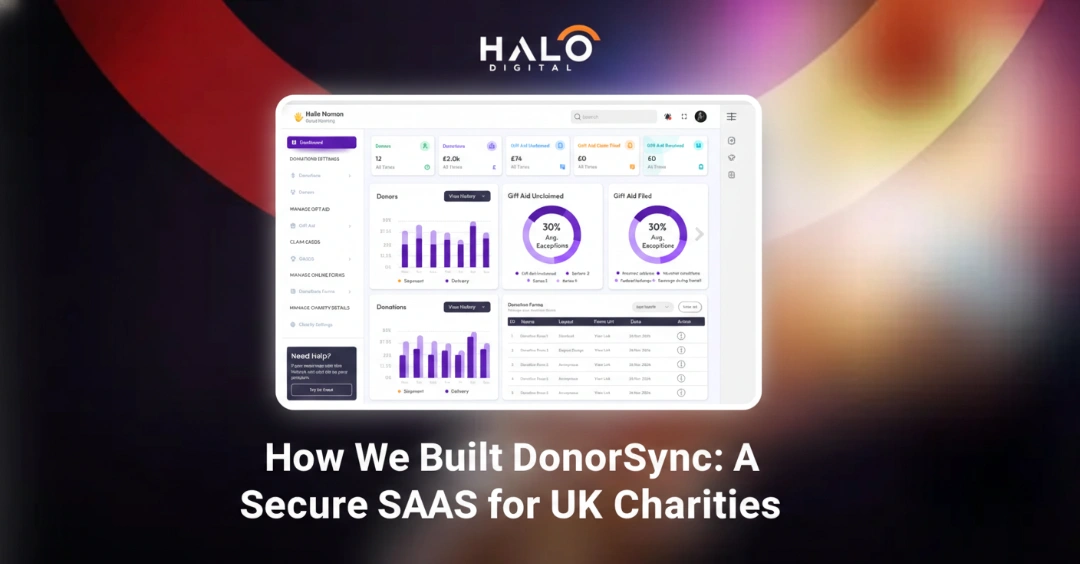
- The Problem: UK charities were losing hours to manual donation processing, spreadsheet-based Gift Aid claims, and disconnected donor management tools.
- Our Solution: We built DonorSync, a full-featured SaaS platform that automates the entire donation lifecycle with Laravel backend, Stripe payments, and AWS infrastructure.
- The Results: 60% faster processing, 100% automated Gift Aid submissions, 10+ charities onboarded, and complete GDPR compliance with 256-bit encryption.
- Tech Stack: Laravel, Node.js, Stripe, PostgreSQL, AWS (EC2, RDS, S3, Lambda), Redis
When DonorSync approached us in early 2024, their goal was clear: develop a SaaS platform to help UK charities manage donations, automate Gift Aid claims, and strengthen donor relationships. The challenge extended beyond building a web application. We needed to foster digital confidence in a sector often limited by outdated tools.
I’m Arsalan Chauhdary, CEO and co-founder of Halo Digital. Over the past eight years, my team and I have delivered digital products for startups, SMBs, and enterprises across three continents. DonorSync stands out not for its technology or features, but for representing a complete SaaS development project that demanded precision in security, compliance, automation, and user experience.
This case study details our approach, key decisions, challenges addressed, and the measurable impact achieved. If you are considering SaaS development or planning your own platform, this serves as a practical blueprint.
What DonorSync Does and Why It Matters?
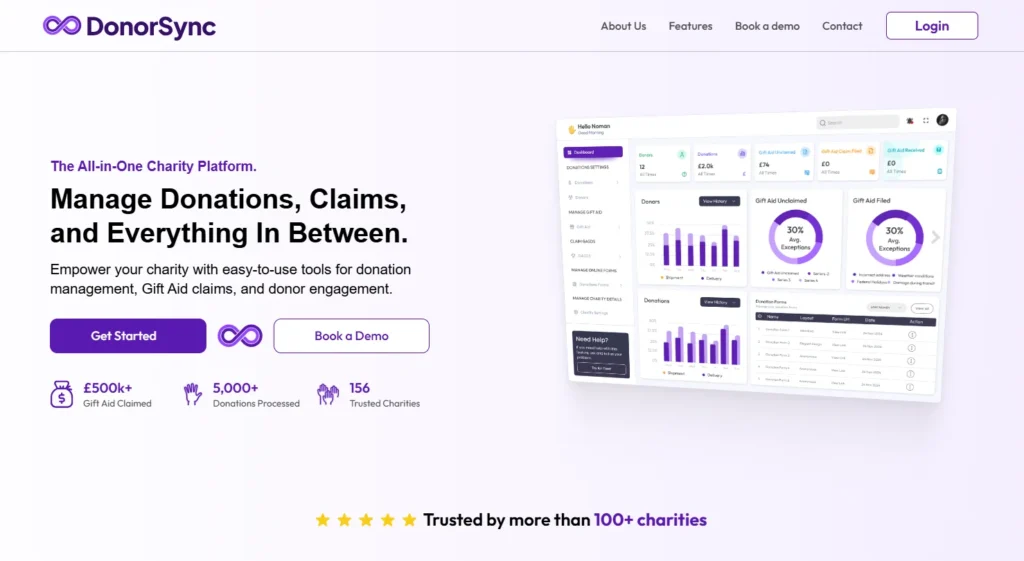
DonorSync is a full-featured SaaS solution designed specifically for charities and nonprofit organizations. It handles the entire donation lifecycle from a single platform. That means donation processing, automated Gift Aid claims, donor relationship management, real-time analytics, and compliance reporting all live in one place.
Before DonorSync, charities were stuck using multiple disconnected tools. One system for payments. Another for donor data. Spreadsheets for Gift Aid. Manual processes everywhere. The result was wasted time, data errors, missed Gift Aid revenue, and frustrated teams.
DonorSync solved this by consolidating everything into a secure, compliant, and easy-to-use platform. Charities can now process donations in seconds, automate Gift Aid submissions with a single click, and access real-time dashboards that show exactly how campaigns are performing.
The platform serves local and global charities, handling sensitive financial and personal data at scale. That meant our development approach had to prioritize three things above everything else: security, compliance, and automation.
The Challenge: Building Trust Through Technology
Most SaaS projects come with technical challenges. But DonorSync came with a different kind of pressure. We weren’t just building software. We were building trust.
Charities handle donor data that includes names, addresses, payment details, and donation histories. This data is protected under GDPR in the UK. A single compliance failure or security breach could destroy trust, trigger legal consequences, and damage the nonprofit’s reputation.
On top of that, the platform needed to integrate with HMRC systems for automated Gift Aid claims. Gift Aid is a UK tax incentive that allows charities to reclaim 25p for every £1 donated by taxpayers. For many charities, Gift Aid represents a significant revenue stream. Automating it accurately meant understanding complex tax rules, handling edge cases, and building a submission system that HMRC could validate without errors.
Then there was the user experience challenge. Charity teams are often small and under-resourced. They don’t have time to learn complicated software or troubleshoot broken workflows. The platform needed to feel intuitive from day one, even for users with minimal technical experience.
Finally, the platform had to scale. DonorSync wasn’t being built for a single charity. It was being built as a multi-tenant SaaS product that could onboard and serve dozens, then hundreds, of organizations simultaneously. This required enterprise web application development practices that would support growth without sacrificing performance or security. That required architecture decisions that would support growth without sacrificing performance or security. Building a B2B web application for nonprofits meant understanding their unique compliance needs, budget constraints, and operational workflows.
Our Development Approach: Strategy Before Code
At Halo Digital, we don’t start projects by writing code. Our software development as a service approach begins with strategic discovery, helping clients understand what they’re building and why before a single line of code is written.
We start by asking the right questions. What problem are we actually solving? Who are the users? What does success look like? What are the constraints?
For DonorSync, we spent the first two weeks in discovery. We interviewed charity administrators, reviewed their existing workflows, studied GDPR and HMRC compliance requirements, and mapped out user journeys for every major task: processing a donation, managing donor profiles, submitting Gift Aid claims, generating reports.
From there, we built a detailed product roadmap that prioritized features based on impact and complexity. We identified the core features that had to be in the MVP: donation processing, donor management, Gift Aid automation, and basic reporting. Everything else, including advanced analytics and third-party integrations, would come in later phases.
This phased approach let us ship a working product faster while maintaining quality. It also gave the DonorSync team the ability to test the platform with real users, gather feedback, and refine features before we added complexity.
The Tech Stack: Why We Chose Laravel, Stripe, and AWS
Choosing the right tech stack for a SaaS platform is one of the most important decisions you’ll make. Get it wrong, and you’ll spend months refactoring code or dealing with performance issues. Get it right, and you’ll have a foundation that scales, stays secure, and makes development faster.
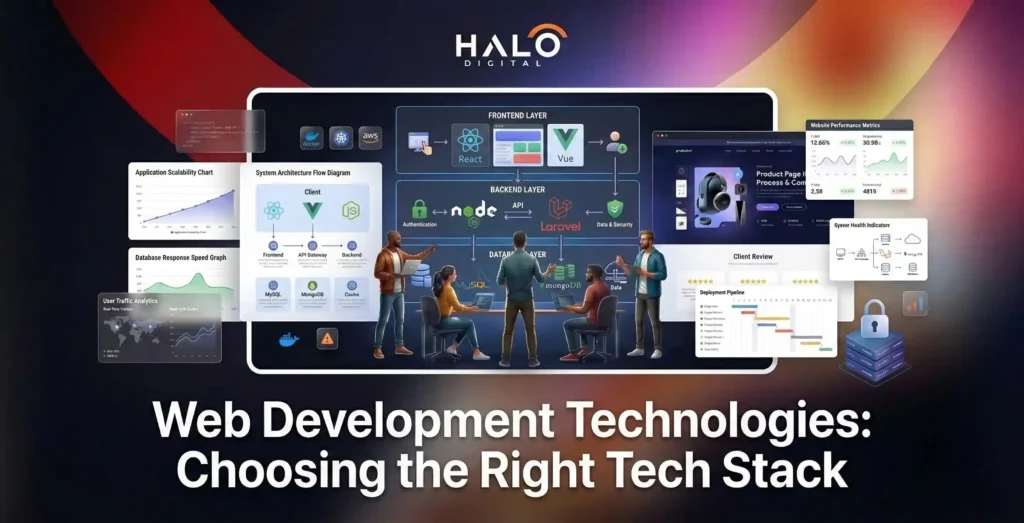
For DonorSync, we went with a stack we’ve used successfully on multiple enterprise projects: Laravel for the backend, Node.js for real-time features, Stripe for payment processing, and AWS for cloud infrastructure. Our web application architecture decisions prioritized security, scalability, and maintainability from the foundation up.
Why Laravel?
Laravel is a PHP framework built for rapid development without sacrificing structure or security. It comes with built-in tools for authentication, database management, job queues, and API development. For a compliance-heavy project like DonorSync, Laravel’s ecosystem gave us what we needed out of the box: encrypted data storage, role-based access control, audit logs, and API rate limiting.
Laravel also has excellent documentation and a massive community, which means faster problem-solving and access to battle-tested packages for everything from PDF generation to CSV exports.
Why Stripe?
Payment processing is not something you build from scratch. It’s something you integrate carefully. Stripe gave us PCI-compliant payment handling, support for one-time and recurring donations, refund management, and detailed transaction logs. It also integrates seamlessly with UK banking systems, which was essential for HMRC Gift Aid reconciliation.
Stripe’s webhook system allowed us to build real-time donation notifications, so charity teams could see incoming donations instantly and thank donors without delay.
Why AWS?
AWS provided the infrastructure scalability and security DonorSync needed. We chose a cloud application approach over traditional web hosting to ensure automatic scaling, geographic redundancy, and enterprise-grade security for charity data. We deployed the platform on EC2 instances behind an Application Load Balancer, used RDS for managed PostgreSQL databases, and stored file uploads in S3 with encryption at rest and in transit.
For compliance, we enabled CloudWatch logging to track every database query, API call, and user action. This audit trail became critical for GDPR compliance, allowing charities to demonstrate exactly how donor data was accessed and used.
We also used AWS Lambda for background tasks like Gift Aid batch processing and report generation. This kept the main application fast and responsive, even during high-traffic periods.
| Technology | Purpose | Why We Chose It |
|---|---|---|
| Laravel | Backend framework | Security, scalability, built-in compliance tools |
| Node.js | Real-time features | WebSocket support for live donation feeds |
| Stripe | Payment processing | PCI compliance, UK banking support, webhooks |
| PostgreSQL | Database | ACID compliance, advanced querying, data integrity |
| AWS EC2 | Application hosting | Auto-scaling, high availability, load balancing |
| AWS RDS | Database hosting | Automated backups, encryption, managed updates |
| AWS S3 | File storage | Secure document storage with encryption |
| Redis | Caching layer | Faster queries, session management, job queues |
Core Features We Built and How They Work
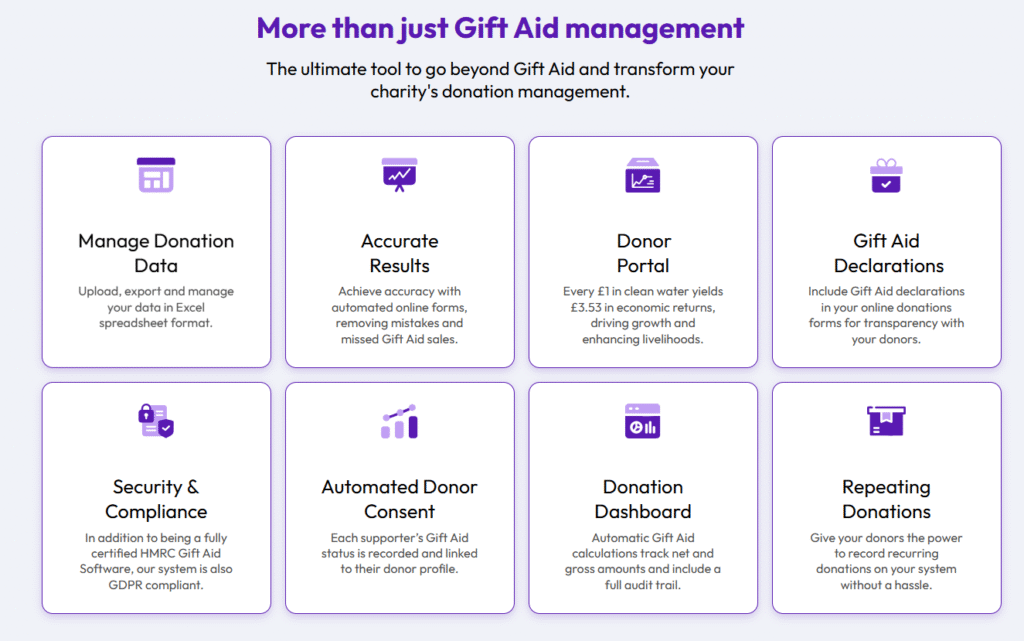
1. Donation Processing System
The donation system is the heart of DonorSync. It needed to handle one-time donations, recurring subscriptions, corporate matching, and offline donation recording all from a single interface.
We built a multi-step donation form that captures donor details, payment information, and Gift Aid declarations in under 60 seconds. The form validates UK postcodes, checks email formats, and provides real-time feedback if something’s wrong.
Behind the scenes, Stripe processes the payment while Laravel creates a donation record, updates donor profiles, sends confirmation emails, and triggers a webhook to the charity’s dashboard so they can see the donation instantly.
For recurring donations, we used Stripe’s subscription API to automatically charge donors on a monthly or annual basis. Charities can view subscription status, send reminders, and handle cancellations without touching code.
2. Gift Aid Automation
Gift Aid automation was the most complex feature we built. HMRC has strict formatting requirements for Gift Aid claims. A single error in a submission file can delay processing or trigger an audit.
We built a system that automatically identifies eligible donations based on the donor’s Gift Aid declaration and taxpayer status. The platform then generates HMRC-compliant CSV files with all required fields: donor name, address, postcode, donation amount, and claim value.
Charities can submit claims directly from DonorSync with a single click. The system tracks submission status, stores confirmation receipts, and alerts the team if there are any issues.
This feature alone saves charities hours of manual data entry every month and eliminates the errors that used to delay Gift Aid revenue.
3. Donor Relationship Management
Managing donor relationships is just as important as processing donations. DonorSync includes a full CRM that lets charities store donor profiles, track donation history, add notes, segment audiences, and send personalized thank-you messages.
The CRM integrates with the donation system, so every time a donor gives, their profile updates automatically. Charities can see lifetime giving totals, average donation amounts, and engagement trends at a glance.
We also built a tagging system that lets charities create custom segments like “monthly donors,” “major donors,” or “lapsed donors.” These segments can then be used for targeted email campaigns or personalized outreach.
4. Real-Time Analytics Dashboard
Data visibility was a major pain point for charities before DonorSync. They had to export spreadsheets, run manual calculations, and wait days to understand campaign performance.
We built a real-time analytics dashboard that shows key metrics the moment they happen: total donations, average gift size, Gift Aid claimed, donor retention rate, and campaign performance.
The dashboard uses Chart.js for visualizations, making it easy to spot trends, compare time periods, and identify high-performing campaigns. Charities can filter data by date range, campaign, or donation type, and export reports as PDFs for board meetings or grant applications.
5. Role-Based Access Control
Many charities have multiple team members who need different levels of access. A finance manager should see financial reports but not donor contact details. A fundraising coordinator should manage campaigns but not process refunds.
We implemented role-based access control (RBAC) that lets charities define custom roles with specific permissions. This keeps data secure, reduces the risk of accidental changes, and ensures compliance with GDPR’s principle of least privilege.
Building a secure, compliant SaaS platform requires the right team and approach. At Halo Digital, we specialize in developing enterprise-grade SaaS solutions with a focus on security, scalability, and user experience. Whether you're targeting healthcare, finance, nonprofits, or any regulated industry, we know how to navigate compliance while delivering products users trust.
Security and Compliance: How We Protected Donor Data
Security wasn’t an afterthought. It was embedded in every decision we made. We followed web application security best practices from day one, ensuring donor data remained protected at every layer of the platform.
All donor data is encrypted at rest using AES-256 encryption and in transit using TLS 1.3. Passwords are hashed with bcrypt. API endpoints require token-based authentication. User sessions expire after 30 minutes of inactivity. Every database query is logged for audit purposes.
For GDPR compliance, we built features that let charities honor data subject requests: donors can view their data, request corrections, download their information, or ask for deletion. The platform tracks consent for marketing communications and provides an audit trail showing when and how consent was obtained.
We also implemented automated backups with point-in-time recovery, so charities can restore data if something goes wrong. Backups are encrypted and stored in multiple AWS regions for redundancy.
Finally, we conducted security testing throughout development, including penetration testing and vulnerability scanning. We addressed every finding before launch using our full stack web application release checklist to ensure nothing was overlooked during the final quality assurance phase. We addressed every finding before launch.
Results: What DonorSync Achieved After Launch
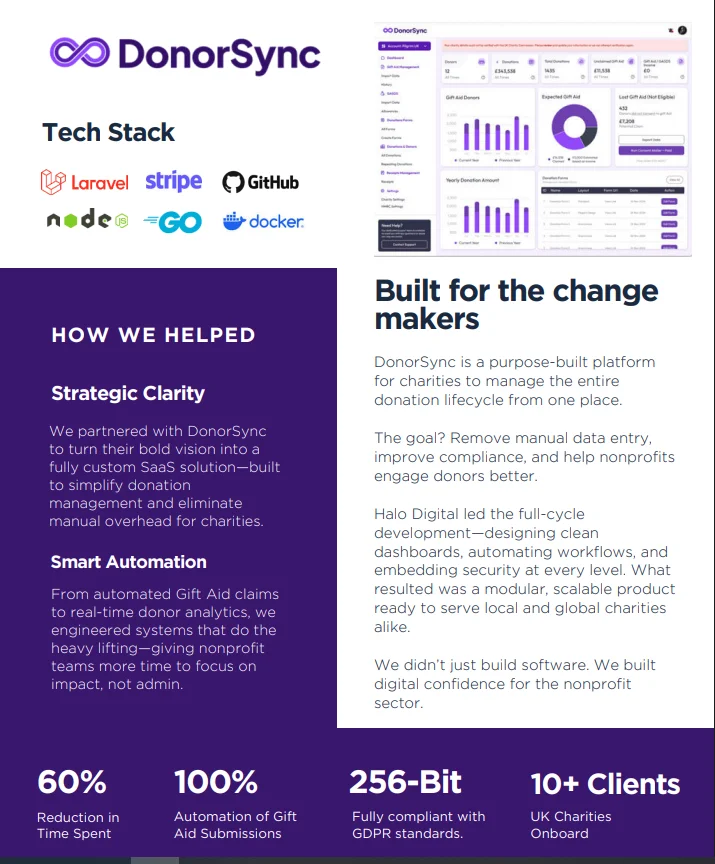
The numbers speak for themselves.
- 60% reduction in time spent on donation processing
- 100% automation of Gift Aid submissions
- 256-bit encryption for full GDPR compliance
- 10+ charities onboarded in the first six months
But the real impact goes beyond metrics. Charity teams told us they finally had digital confidence. They could trust the platform with their most sensitive data. They could focus on their mission instead of fighting with software. They could show donors that their contributions were being managed professionally and transparently.
One charity administrator told us, “We used to spend hours every month reconciling donations and preparing Gift Aid claims. Now it takes minutes. DonorSync gave us time back to focus on the people we serve.”
That’s the kind of impact that makes a SaaS project successful.
Lessons Learned: What We’d Do Differently
No project is perfect. If we were starting DonorSync today, here’s what we’d do differently.
First, we’d invest more time in user testing during the design phase. We ran usability tests before launch, but earlier feedback would have helped us refine the interface faster.
Second, we’d build more robust onboarding automation. In the early days, onboarding new charities required manual configuration. We’ve since automated most of that process, but building it into the MVP would have saved time.
Third, we’d implement more proactive monitoring from day one. We added error tracking and performance monitoring after launch, but having those tools in place during beta testing would have helped us catch issues sooner.
Proper DevOps adoption from the start would have streamlined our deployment pipeline and improved our ability to detect issues before they reached production.
These are minor adjustments, but they’re worth noting because they improved our process for future projects.
How This Applies to Your SaaS Development Project
If you’re planning to build a SaaS platform, here’s what DonorSync can teach you.
Start with clarity. The most successful SaaS projects begin with a clear understanding of the problem, the users, and the constraints. Spend time in discovery. Map out workflows. Talk to real users. Don’t skip this step.
Choose your tech stack carefully. Pick technologies that support your compliance requirements, performance goals, and team expertise. Don’t chase trends. Choose tools that have been battle-tested in production environments.
Prioritize security from day one. Security is not a feature you add later. It’s a foundation you build on. Encrypt data, implement access controls, log everything, and test relentlessly.
Automate intelligently. Automation is powerful, but only when it’s accurate. DonorSync’s Gift Aid automation works because we spent weeks understanding HMRC requirements and building error handling into every step.
Design for real users. The best SaaS platforms feel intuitive because they were designed with real user workflows in mind. Don’t build features in isolation. Build them in context.
Why We Built DonorSync the Way We Did
At Halo Digital, we treat every project like it’s our own. That means asking hard questions, challenging assumptions, and making decisions that prioritize long-term success over short-term shortcuts.
DonorSync required precision, patience, and a deep commitment to quality. We could have rushed the project, skipped security testing, or delivered a minimum viable product that barely worked. But that’s not how we operate.
We built DonorSync the way we’d want it built if we were the ones relying on it. We embedded security at every level. We automated processes that saved real time. We designed interfaces that felt natural. We tested edge cases that most teams would miss.
The result is a platform that charities trust with their most sensitive data and their most important relationships. That trust is earned through careful work, not clever marketing.
Ready to Build Your SaaS Platform?
Building a SaaS platform is not simple. It requires strategic thinking, technical expertise, and a commitment to quality that extends far beyond launch day. But when it’s done right, it creates value that compounds over time.
If you’re planning a SaaS project and want to work with a team that treats your product like their own, let’s talk. At Halo Digital, we specialize in building secure, scalable, and compliant platforms for startups and enterprises.
We’ve built donation management systems for nonprofits, spiritual tech platforms for pilgrims, and enterprise portals for multinational organizations. We know how to navigate compliance requirements, architect for scale, and deliver products that users trust.
Start your project with Halo Digital or explore our custom software development services to see how we approach complex digital products.

Arsalan Chauhdary is the CEO and Co-Founder of Halo Digital, a full-spectrum software development agency serving startups and enterprises globally. Over the past 10 years, he has led the architecture and development of platforms used by millions of people across 160+ countries, including DonorSync (GDPR-compliant charity SaaS), Pilgrim (faith-based mobile app with 50K+ users), and enterprise portals for multinational organizations. His work has been referenced by Cloudways and published on Creately. Arsalan Tariq specializes in Laravel, AWS, and building secure, scalable systems for regulated industries including healthcare, finance, and nonprofits. At Halo Digital, he leads a multidisciplinary team focused on delivering products that prioritize security, compliance, and long-term impact.