










- Budget Reality: Expect to invest between $60,000 and $120,000 for a functional telemedicine MVP in 2026, while enterprise solutions can exceed $300,000 due to security demands.
- Compliance is Key: HIPAA and GDPR compliance are not optional add-ons; they require specific infrastructure that can consume 20% of your initial budget.
- Hidden Costs Exist: Maintenance, third-party API fees for video or payments, and annual security audits often catch founders off guard.
- Strategic Savings: You can reduce initial costs by up to 40% by choosing hybrid development frameworks like Flutter instead of building separate native apps.
- Expertise Matters: Partnering with a specialized agency like HALO Digital minimizes regulatory risk and ensures faster market entry compared to generalist developers.
The mHealth market is projected to exceed $300 billion by 2028. You are likely here because you see the massive potential in this growth. However, building a digital health product is not like launching a standard lifestyle app or e-commerce store. The costs are significantly higher. The regulations, such as HIPAA and HITECH, are non-negotiable. The stakes involve sensitive patient data, where a single breach can end a business.
I have seen many founders underestimate the healthcare app development cost because they focus only on features rather than compliance. This healthcare app development cost guide provides a transparent, no-nonsense breakdown of exactly what you will pay in 2026. We will cover costs by app type, detail the hidden factors, and give you 5 actionable strategies to reduce your budget without compromising on quality or compliance.
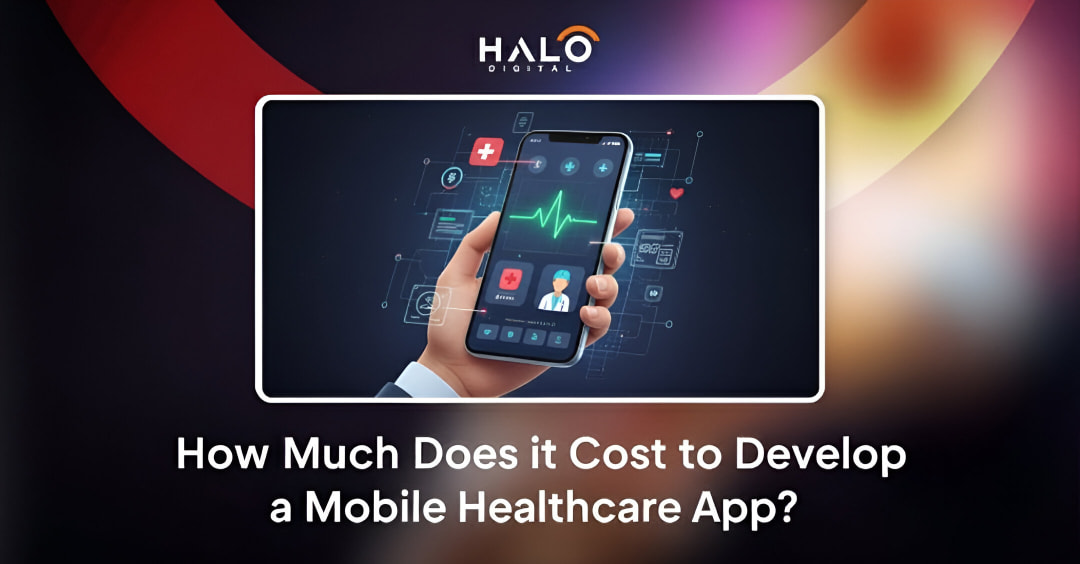
How Much Does it Cost to Develop a Mobile Healthcare App?
The cost to develop a mobile healthcare app typically ranges from $30,000 to over $300,000, depending on whether you’re building a simple reminder app, a telemedicine MVP, or a complex EMR/EHR system.
| App Complexity | Estimated Cost | Key Characteristics |
|---|---|---|
| Simple App (e.g., Medication Reminders) | $30,000 to $60,000 | Single platform deployment, basic user interface, minimal backend integration, standard features. |
| Medium App (e.g., Telemedicine MVP) | $60,000 to $120,000 | Hybrid development, custom UI design, API integrations for video/chat, secure patient database. |
| Complex App (e.g., Full EMR/EHR System) | $120,000 to $300,000+ | Native performance, AI diagnostics, IoT device connectivity, multiple third-party integrations, advanced security. |
Cost Breakdown by Healthcare App Type (The Detailed Answer)
The type of application you build dictates your technical requirements and your final invoice. Here is what you can expect for the most common categories in 2026.
1. Telemedicine & Telehealth Apps (e.g., Teladoc)
Estimated Cost: $70,000 to $150,000
Telemedicine is the cornerstone of modern mHealth. The cost driver here is real-time communication. You are building a secure video conferencing tool. You need high-definition video capabilities that work even on poor connections.
You also need a secure messaging layer for doctors and patients to chat. Features like appointment booking and e-prescription (eRx) modules add significant development time. We also have to build separate dashboards for doctors (to manage schedules) and patients (to view history).
2. Patient Engagement & Wellness Apps (e.g., MyFitnessPal)
Estimated Cost: $40,000 to $90,000
These apps focus on the user’s daily habits. While they might seem simpler, effective engagement requires complex logic. We focus heavily on user tracking and data visualization. Users want to see their progress in beautiful, easy-to-read charts. Gamification elements like badges or streaks are essential to keep retention high.
You will also need a robust Content Management System (CMS) to push educational articles or health tips to users regularly. If you plan to monetize this, integrating mobile app development strategies early is crucial.
3. Remote Patient Monitoring (RPM) & IoT Apps (e.g., CareLink)
Estimated Cost: $80,000 to $200,000+
RPM apps are technically demanding. They must connect via Bluetooth or Wi-Fi to external hardware like heart rate monitors, glucose meters, or smart scales. The cost spikes because of the need for real-time data synchronization. The app must read data from a device, process it, and send it to a doctor instantly.
We also have to build logic for “alerts” that notify medical staff if a patient’s vitals go out of range. This requires rigorous testing to ensure accuracy, as a failed alert could be life-threatening.
4. EMR/EHR & Hospital Admin Apps (e.g., Healow)
Estimated Cost: $100,000 to $300,000+
This is the enterprise level of development. These apps serve as the digital backbone for clinics or hospitals, especially when integrated with advanced EMR/EHR Software.
The primary cost driver is the database architecture, which must handle massive amounts of records while maintaining speed.
You are dealing with multiple user roles, including admins, doctors, nurses, and billing staff, all requiring secure access and seamless performance.
Each role needs different access permissions. Integration with legacy systems is often required, which can be a slow and expensive process. Security here is paramount and usually involves enterprise web application development standards.
5. Appointment Booking & Scheduling Apps (e.g., Zocdoc)
Estimated Cost: $50,000 to $100,000
These apps solve a logistical problem. The core complexity lies in calendar management. You need to prevent double-booking across multiple doctors and time zones. The system must verify insurance eligibility in real-time, which requires connecting to insurance clearinghouses.
Automated reminders via push notifications or SMS are standard features that reduce no-show rates. You also need a robust search function so patients can filter doctors by specialty, location, or insurance acceptance.
Stop guessing your budget and start planning your success. We can give you a precise estimate based on your specific feature list.
The 7 Key Factors That Drive Your mHealth App Cost
1. Security & Compliance (HIPAA, HITECH, GDPR)
This is the single most critical factor. You cannot cut corners here. Compliance adds cost because every piece of data must be encrypted both in transit and at rest. We have to configure secure servers, implement automatic session timeouts, and build detailed audit trails that log every user action.
We also need legal agreements like BAAs (Business Associate Agreements) with your hosting providers. Implementing these mobile app quality assurance protocols takes time and specialized knowledge.
2. Feature Set & App Complexity
The more the app does, the more it costs. Simple data entry is cheap. However, features like Artificial Intelligence (AI) for symptom diagnosis or Machine Learning (ML) for predicting patient outcomes are expensive.
Real-time video and secure chat require ongoing server resources and third-party API fees. IoT integration increases the scope of testing significantly.
3. Platform Choice (Native vs. Hybrid)
Developing separate native apps for iOS (Swift) and Android (Kotlin) essentially means building two products. This doubles your development and maintenance costs. Choosing hybrid development frameworks like Flutter or React Native allows us to write code once and deploy it to both platforms.
This approach can often reduce your initial platform costs by 40% without sacrificing performance.
4. Third-Party Integrations
Your app rarely lives in isolation. You will likely need to connect to external systems.
- EHR/EMR: Integrating with Epic or Cerner uses standards like HL7 or FHIR and is complex.
- Payment Gateways: Stripe or PayPal for processing consultation fees.
- Pharmacy APIs: Connecting to services like GoodRx for medication pricing.
- Insurance Verification: Automated checks for patient coverage.
Each integration requires reading documentation, writing code, and testing for failure points.
5. Custom UI/UX Design
Design in healthcare is tricky. A doctor needs a data-heavy, clinical view that allows them to scan information quickly. A patient needs a simple, friendly, and accessible interface. Designing these distinct experiences takes time. We also have to ensure accessibility standards (WCAG) are met so users with disabilities can navigate your app. Investing in good web designs ensures your professional users remain efficient.
6. Backend Infrastructure
The backend is the brain of your app. It manages the database, the users, and the logic. For healthcare, we cannot just use a cheap shared server. We must use scalable, secure cloud infrastructure like AWS or Azure that offers HIPAA-compliant configurations. Setting up this architecture correctly from day one prevents costly migrations later.
7. Post-Launch Maintenance & Support
This is the “hidden cost” many founders forget. Once the app is live, the work is not done. You need a budget for operating system updates (iOS updates every year), security patches, and server monitoring. If a third-party API changes its code, your app needs to be updated to match. We generally recommend allocating 15% to 20% of your initial development budget for annual maintenance.
How do you budget for healthcare app development?
Phase 1: Discovery & Planning (10% to 15% of Budget)
We start by defining exactly what you are building. We conduct market research to validate your idea. We create a detailed feature list and a technical specification document. We also outline the compliance strategy. This phase prevents “scope creep” where the project grows uncontrollably later. Services like software development as a service can help structure this ongoing relationship.
Phase 2: UI/UX Design (15% to 20% of Budget)
Here we visualize the product. We build wireframes to map out the user journey. Then we create high-fidelity prototypes that look exactly like the final app. We test these with users to ensure the flow makes sense. We also focus heavily on accessibility design during this phase.
Phase 3: Development (40% to 50% of Budget)
This is the heavy lifting. Our engineers write the code for the backend, the API, and the mobile app itself. This takes the most time and resources. We work in “sprints,” delivering chunks of the app for you to review every two weeks. This ensures we are always aligned with your vision.
Phase 4: QA & Compliance Audit (20% to 25% of Budget)
We do not ship until it is perfect. We perform unit testing, integration testing, and manual user testing. Crucially, we perform a specific HIPAA compliance check and often hire external penetration testers to try and hack the app. This ensures your patient data is safe. A rigorous full stack web application release checklist is essential here.
5 Smart Strategies to Reduce Healthcare App Costs (Without Sacrificing Quality)
1. Launch a Minimum Viable Product (MVP)
Do not try to build everything at once. Start with the 1 or 2 core features that solve the biggest problem. Launch that version to a small group of users. Get their feedback. Then iterate. This saves you from building expensive features that nobody actually uses.
2. Choose Hybrid App Development
As mentioned, building for both iOS and Android simultaneously using a hybrid framework saves massive amounts of time and money. It also simplifies your future maintenance because you only have one codebase to update. This is a key decision in desktop vs web application discussions as well.
3. Prioritize Features with the MoSCoW Method
We help you categorize features into Must Have, Should Have, Could Have, and Won’t Have. We only build the “Must Haves” in the first phase. This strict prioritization keeps the budget focused on value.
4. Leverage Pre-built Modules & Third-Party APIs
There is no need to reinvent the wheel. Do not build a video chat engine from scratch; integrate a secure, HIPAA-compliant API like Twilio or Zoom SDK. It costs a monthly fee but saves tens of thousands in upfront development costs.
5. Partner with a Specialized Agency (Not a Generalist)
A generalist developer will learn HIPAA requirements on your dime. They will make mistakes that cost you money to fix. An expert agency like HALO Digital already has the security protocols, the code libraries, and the experience to build efficiently. We get it right the first time.
Cost Models: How Your Partner Choice Affects the Bill
Fixed Price
This model is good for small, well-defined MVPs where the scope is crystal clear. The risk is on the agency to deliver within the budget. However, it offers less flexibility if you want to change things during development.
Time & Materials
This is best for complex, evolving projects. You pay for the actual hours worked. It requires trust, but it allows us to pivot quickly if user feedback suggests a change. It often results in a better final product because we are not rushing to meet an arbitrary fixed scope.
Team Location: A Quick Comparison
| Region | Average Hourly Rate |
|---|---|
| USA / Canada | $100 to $180 |
| Western Europe | $80 to $150 |
| Eastern Europe | $40 to $80 |
| HALO Digital | Contact us for our competitive value-driven rates |
Conclusion
The healthcare app development cost range of $30,000 to $300,000+ is significant. However, you must view it as an investment rather than an expense. The ROI comes from improved patient outcomes, increased operational efficiency for your clinic, and entirely new revenue streams. You are building an asset that solves real human problems.
Let’s Build Something Healthy with HALO Digital
At HALO Digital, we don’t just write code; we build compliant, scalable businesses. We have navigated the complexities of healthcare development for founders just like you. Check out our case studies to see our success stories.
[Partner With HALO Digital]
Frequently Asked Questions (FAQs)
How much does HIPAA compliance add to the app cost?
HIPAA compliance typically adds 20% to 30% to the total app development cost, because it requires encryption, secure hosting, audit logs, and extensive security testing.
How do healthcare apps make money (monetization models)?
Healthcare apps make money through subscriptions, appointment transaction fees, freemium upgrades, or by offering anonymized data to research institutions.
How long does it take to build a healthcare app?
Building a healthcare app typically takes 3–4 months for an MVP and 9–12 months or longer for a full-scale, integrated medical system.
What are the hidden costs in mHealth development?
Hidden costs in mHealth development often include third-party API fees, cloud hosting charges, annual security audits, and ongoing maintenance for OS updates.
Is it cheaper to build a wellness app than a medical app?
Yes, building a wellness app is usually cheaper than a medical app because wellness products avoid strict compliance rules and require fewer clinical data integrations.

Abdullah Mangi is an SEO strategist and content writer with 5 years of experience helping businesses grow online. He writes about programming, tech, online business, and practical how-to topics. Abdullah has worked with clients in SaaS, software development, web design, link building, yacht rentals, gardening, car rentals, and recruitment.