Key Takeaways
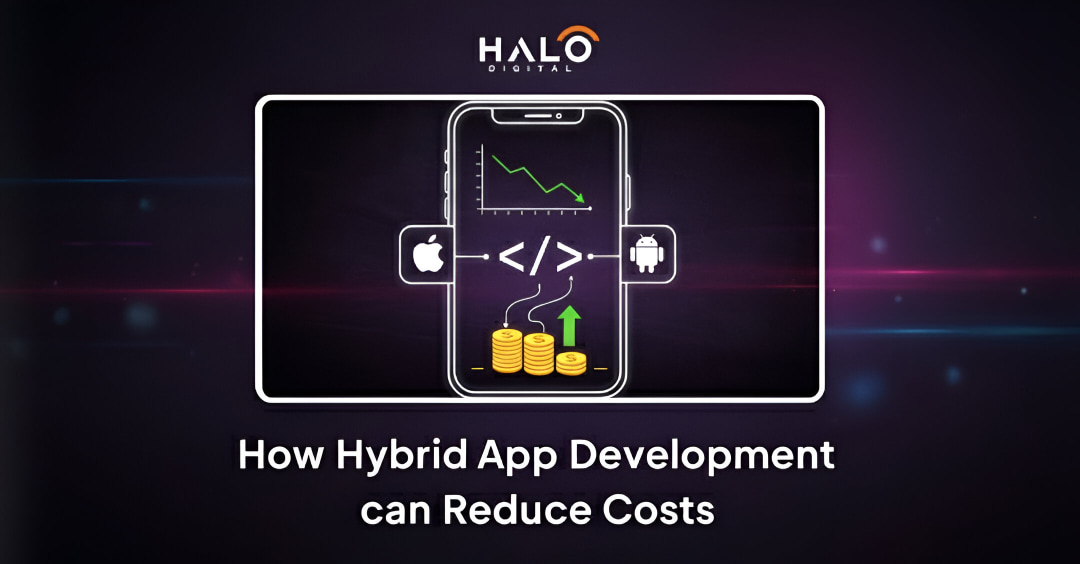
- Hybrid development builds one application for both iOS and Android. It does not require two separate codebases.
- This “write once, run everywhere” model is the single biggest way to reduce app development costs.
- Your long term app development TCO (Total Cost of Ownership) is lower. You only need to maintain and update one codebase, not two.
- Modern hybrid frameworks like Flutter and React Native deliver fast, smooth, near native performance. The old “hybrid is slow” myth is dead.
- A faster hybrid app time to market is a key benefit. You can launch on both app stores in months, not a year, and start earning revenue sooner.
The median cost for a complex native app can exceed $150,000. That is per platform. As the founder of an agency, I see businesses face this painful choice every day. Do you build for iOS or Android first? You risk alienating half your potential audience right from the start. Or, you can double your budget. You can pay for two full development cycles. Most businesses believe this is their only option. They think they must build two expensive, separate, native apps to get the quality and performance they need.
This is a false choice. It is a budget trap.
Hybrid app development offers a strategic, financially sound alternative. It delivers a high-quality, near-native experience. It does so without the astronomical price tag. This guide will show you exactly how hybrid app development reduces your costs. It will detail how to avoid the trap and get your app to market smarter and faster.
What is Hybrid App Development?
It is one single application. It is built from one single codebase. This one app, however, is packaged to run perfectly on both iOS and Android. It looks and feels like a native app on each device.
Think of a hybrid app as a “chameleon.”
How does this work? We do not use jargon here. The concept is simple. We use a framework like React Native or Flutter. These tools act as a “bridge.” They let us write code once using a common language (like JavaScript or Dart). The framework then translates or “compiles” that code into the native building blocks for iOS and Android.
The core principle is powerful: Write Once, Run Everywhere.
This is not the same as developing a web app. A web app simply runs in a phone’s browser. A hybrid app is a real app. You download it from the Apple App Store or Google Play Store. It is installed on your device.
Here is a simple table to show the difference.
Hybrid vs. Native vs. Web App: A Simple Comparison
| Feature | Native App (Swift/Kotlin) | Hybrid App (React Native/Flutter) | Web App (In Browser) |
|---|---|---|---|
| Development Cost | Very High | Medium | Low |
| Time to Market | Slow (Two separate apps) | Fast (One codebase) | Very Fast |
| Performance | Excellent (Best possible) | Very Good (Near Native) | Good (Browser Dependant) |
| App Store Access | Yes (Required) | Yes (Required) | No (Runs in browser) |
| Device Feature Access | Full Access (Camera, GPS etc.) | Full Access (Via bridges) | Limited Access |
The table makes the “sweet spot” obvious. Hybrid apps give you the best balance. You get App Store access and full device features. You get great performance. But you avoid the massive hybrid vs native app development cost and slow timeline of native.
The 7 Main Ways Hybrid App Development Can Reduce Costs
The savings are not just a small percentage. They are foundational. They change the entire financial model of your project. As an agency, we build apps both ways. I want to break down the seven main ways we see clients reduce web app development costs by choosing a hybrid strategy.
1. The “Code Once” Multiplier (The Biggest Saver)
This is the most significant cost saver. There is no contest.
In a traditional native project, you have two separate teams.
- One team writes your iOS app in Swift or Objective C.
- A second team writes your Android app in Kotlin or Java.
You are paying two specialist teams. You are paying them to build the exact same features twice. They build the login screen twice. They build the user profile twice. They build the checkout process twice.
With hybrid development, you have one team. They write one codebase.
A framework like Flutter or React Native handles the hard work. It compiles that single code into an app for iOS and an app for Android. This is not just a 50% saving on developer salaries. It is often more.
It simplifies project management. It unifies the team. It removes redundant communication. This is the number one factor that lowers the high native app development cost.
2. Accelerated Time-to-Market
In business, time is money. It is a fact.
A faster hybrid app time to market means you start earning revenue sooner. You get critical user feedback faster. You can iterate and improve before your competition even launches.
Building two complete native apps takes a long time. For a complex application, we often budget 9 to 12 months.
A hybrid app can be designed, built, tested, and launched in 4 to 6 months.
Fewer development months mean fewer billable hours. It means your internal team is focused for a shorter period. The math is simple. Launching in half the time saves you a massive amount of capital.
3. Dramatically Simplified Maintenance & Updates
This is the hidden cost of native apps. I call it the “maintenance iceberg.”
Launching your app is just the tip. The real, long-term cost is the support and maintenance after launch.
Imagine a user finds a bug in the payment screen.
- With native: You now have to pay your two teams. The iOS team investigates and fixes the bug in the Swift code. The Android team investigates and fixes the same bug in the Kotlin code. You have to test it twice. You have to deploy two separate updates to two app stores. You paid twice for one fix.
- With hybrid: You find the bug. Your team fixes it once in the core codebase. They test it. They deploy the update.
This cuts your long term app development TCO (Total Cost of Ownership) by 50% or more. At HALO Digital, we build products for their entire lifecycle. Thinking about TCO is critical.
4. Leaner, More Flexible Development Teams
Hiring is a major business challenge. Finding an expert Swift developer and an expert Kotlin developer is difficult. They are niche specialists and are very expensive.
Hybrid development leverages more common and accessible technologies.
- React Native uses JavaScript (via React). This is the most popular programming language in the world.
- Flutter uses Dart. It is a modern language backed by Google. It is known for being easy to learn for developers.
This means the talent pool is much larger. We can build a leaner, more flexible, and more efficient team. The costs for this talent are more manageable. That saving is passed directly on to our clients.
When you choose a mobile app development company in Atlanta or any other state, for example, you want a partner with a deep bench of this flexible talent, not just a few siloed native developers.
5. Reduced QA & Testing Overheads
Quality Assurance (QA) is nonnegotiable. It is also a very time-consuming part of any project.
With two native apps, your QA team must run two full, separate test plans. They test every feature, every button, and every user flow on iOS. Then, they have to do it all over again on Android. This is double the work.
With a hybrid app, the core business logic is tested once. The “submit order” function is the same code. The QA team can validate it one time.
Their time is then focused on more valuable tasks. They check for minor, platform-specific UI tweaks. For example, how does a menu render on a Samsung phone versus an iPhone? This does not mean we skip testing. It means our testing is smarter. It is more efficient. It cuts out thousands of hours of redundant work.
6. Unified UI/UX Design & Adaptation
Design is another area where you find significant savings.
For a strict native app project, you might run two parallel design projects. One designer follows Apple’s Human Interface Guidelines. Another designer follows Google’s Material Design. This means two sets of wireframes. Two sets of prototypes.
With hybrid, you design one set of wireframes. You create one primary user flow. You establish one core brand identity.
Of course, a good agency (like us) will adapt components. We make the app feel native on each platform. An alert box will look like an iOS alert on an iPhone. It will look like an Android alert on a Samsung. But we are not starting from scratch twice. The core user journey is unified. This saves significant design time and budget.
7. Lower Backend & Infrastructure Costs
This is a more technical point, but it affects your monthly bills.
Your app needs to “talk” to a server. This communication happens through an API (Application Programming Interface). When you have two separate native clients, you often have to manage and version two clients. This can complicate your backend architecture.
With a single hybrid application, you are building one backend. It is designed to serve one application. This simplifies your API management. It can reduce server load and complexity. This, in turn, lowers your monthly infrastructure and hosting bills.
The Hybrid Advantage: Key Benefits Beyond Just Cost
The hybrid app development benefits are not just about the initial price tag. The cost saving is what gets your attention. But the real advantages I see for my clients are strategic.
- Cross Platform Reach: This is the most obvious one. You reach 100% of your potential market from day one. You are on the Apple App Store and the Google Play Store simultaneously. No more “Sorry, Android version coming soon.”
- Native Like User Experience (UX): Let’s be clear. Modern hybrid apps feel amazing. Using frameworks like Flutter, we create smooth, 60 fps animations. The apps are responsive, fluid, and fast. They are not the sluggish, wrapped web pages of a decade ago.
- Full Hardware Access: This is a big one. Hybrid apps can use all the phone’s hardware. We build apps that use the camera. We use GPS for location tracking. We use the accelerometer. We use Face ID and fingerprint scanners for secure login. Anything a native app can do, a hybrid app can do via its “bridge.”
- Scalability: Hybrid apps are highly scalable. Because they are often built on web technologies and principles, they are designed to scale. We build them on efficient, cloud-native backends. They can support millions of users without issue.
- Faster Updates: Need to push a new feature or a critical fix? You can do it faster. Because you are only updating one codebase, the cycle is shorter. Some frameworks even support “over the air” (OTA) updates for minor changes. This lets you bypass the app store review time. This agility is a huge competitive edge.
Financial Analysis: A Head-to-Head Cost Breakdown (Native vs. Hybrid)
Let’s stop talking in concepts and look at some real numbers. As an agency, we quote projects every week. I want to share a realistic scenario that I see all the time.
Case Study: The $50,000 MVP
Let’s say you are a startup. You have a great idea for an app. You have raised a seed round. Your budget for a Minimum Viable Product (MVP) is $50,000.
The Native MVP Path
You come to us and say you want an iOS app and an Android app. We scope it out. To build your MVP on both platforms, your team needs:
- 1 iOS Developer
- 1 Android Developer
- 1 Backend Developer
- 1 Project Manager
- 1 QA Tester
We estimate this team will take 4 months. The cost for this team and timeline comes out to $100,000.
You only have $50,000. You are now forced to make a terrible choice. “Okay,” you say, “let’s just build the iOS app for now.” You have just cut your potential market in half.
The Hybrid MVP Path
You come to us with the same idea. We recommend a hybrid approach with Flutter. To build your MVP on both platforms, your team needs:
- 1 Hybrid (Flutter) Developer
- 1 Backend Developer
- 1 Project Manager
- 1 QA Tester
We estimate this leaner team will also take 4 months. The cost for this team comes out to $60,000.
This is much closer to your $50,000 budget. We can now have a real conversation. We can look for one or two features to push to “phase 2.” We can get the project cost down to $50,000.
You walk away with an app for both iOS and Android. You launch to your full audience. The hybrid vs native app development cost was the difference between launching your business and cutting it in half.
Visualizing the 2 Year Total Cost of Ownership (TCO)
Now, let’s look past launch day. Your app development TCO is the real number that matters to your business’s health.
I want you to visualize a simple bar chart.
Native App TCO
- Year 1: A very tall bar. This includes the [High Initial Dev Cost] + [High (x2) Maintenance Cost].
- Year 2: Another tall bar. This is the [High (x2) Maintenance Cost] for bug fixes and new OS versions.
Hybrid App TCO
- Year 1: A medium bar. This is the [Medium Initial Dev Cost] + [Low (x1) Maintenance Cost].
- Year 2: A short bar. This is just the [Low (x1) Maintenance Cost].
The visual is clear. The cost gap between native and hybrid widens dramatically over time. The maintenance savings from hybrid development compound month after month. After two years, you may have saved enough money to build an entirely new feature set.
Stop Guessing Your App Budget
You are paying for two apps but only getting one business. Let’s fix that. Get a clear, no-obligation cost analysis from our team. We can show you the exact TCO difference for your project.