








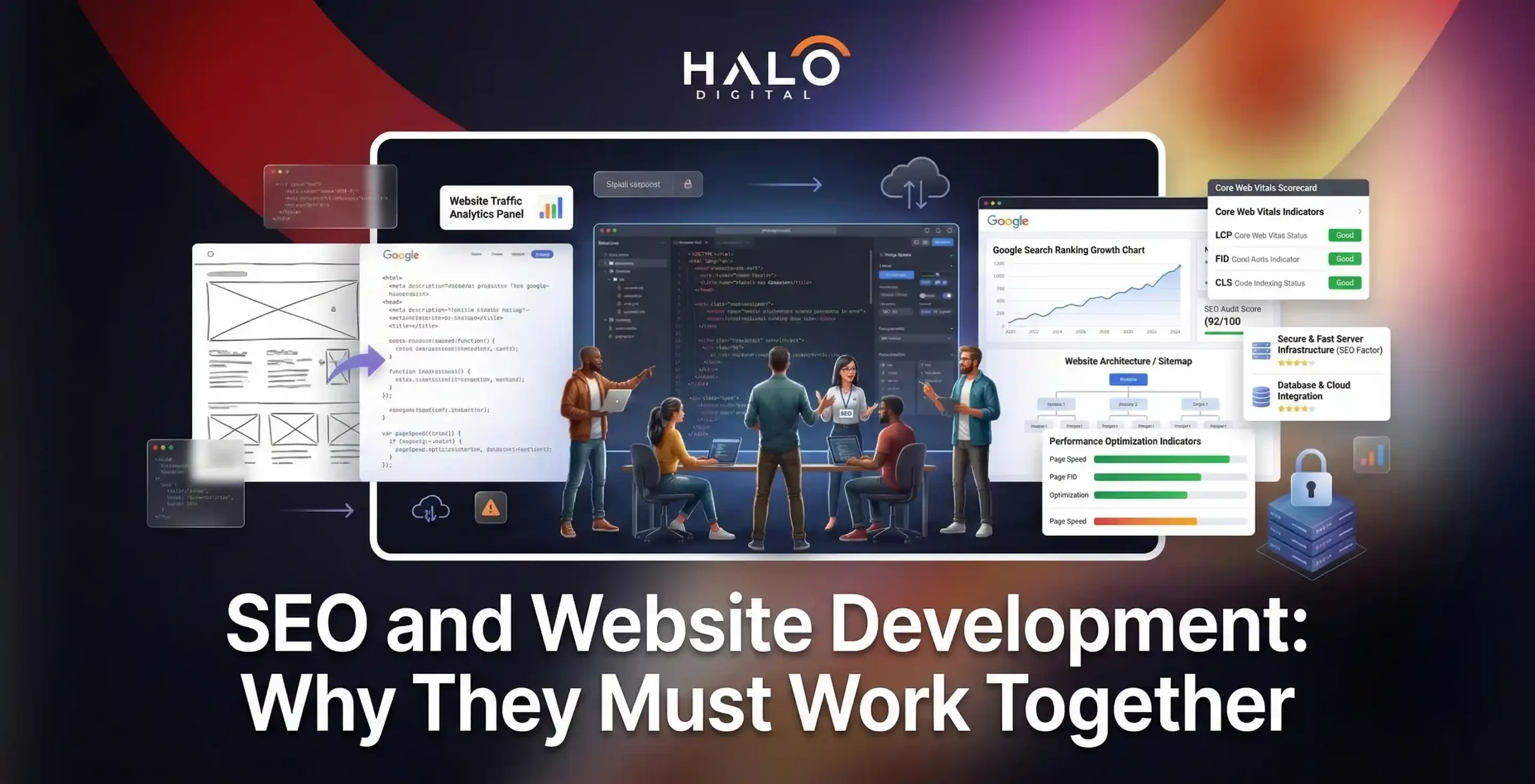
SEO and website development must be integrated from day one because a website’s technical foundation dictates its search engine visibility. Even the highest-quality content will fail to rank if the website suffers from slow load speeds, poor mobile responsiveness, or messy code. SEO is not an afterthought; it is an architectural decision.
Key Development Factors That Impact SEO:
Site Architecture & Navigation: Logical URL structures and clear internal linking ensure search engine crawlers can efficiently discover and index every page.
Core Web Vitals: Page speed and visual stability are direct Google ranking factors. Developers control this via image compression, efficient coding, and optimal hosting.
Mobile-First Indexing: Google evaluates and ranks your site based entirely on its mobile version, making flawless responsive design a strict SEO requirement.
Code Quality & Indexability: Semantic HTML, proper canonical tags, XML sitemaps, and HTTPS security guide search bots accurately and prevent duplicate content penalties.
Cost Efficiency: Integrating SEO into the initial development brief eliminates the need for expensive, time-consuming technical audits and structural rebuilds after launch.
Most businesses treat SEO and website development as two separate conversations. One happens with the marketing team, the other with the developers, and rarely do the two sit in the same room before a site goes live.
The result is a beautiful website that no one can find, or a technically optimized page that fails to convert visitors into customers.
Understanding the anatomy of a high-converting business website requires bridging this exact gap between traffic-driving SEO and seamless user experience.
At Halo Digital, we have built SaaS platforms, mobile apps, and high-performance web solutions for brands across the US, UAE, and UK.
One thing we see consistently is this: the websites that rank well and convert well are the ones where web development best practices and SEO strategy were aligned from the very beginning.
Website structure, page speed, technical SEO, on-page optimization, and mobile responsiveness are not afterthoughts. They are architectural decisions.
This guide breaks down exactly how SEO and website development interact, what web development factors impact your search rankings, and how building the two together from the start gives your brand a compounding advantage over competitors.
What SEO Actually Means in the Context of Web Development
Search Engine Optimization, when stripped of its buzzword status, is the process of making your website easy for search engines to find, understand, and rank. It covers two broad areas: on-page SEO, which deals with content, keywords, meta tags, and headings, and technical SEO, which deals with how your site is built, how fast it loads, how cleanly it is coded, and how logically it is structured.
Web development is the foundation on which all SEO efforts either succeed or fail. You can write the most well-researched, keyword-rich content in your industry, but if your site has slow load times, broken code, poor mobile responsiveness, or a confusing URL structure, Google will push it down regardless. The algorithm does not separate your design choices from your content quality. It evaluates the full experience.
If you want to understand this dynamic further, exploring how web design impacts content marketing highlights exactly why great articles often fail on poorly structured sites.
This is why the relationship between SEO and website development is not optional. It is structural.
The Web Development Factors That Directly Impact SEO Rankings
Understanding which development decisions affect your search visibility helps you prioritize correctly, especially when you are working with limited time or budget. Here are the factors that carry the most weight.
Site Structure and Navigation
A website’s structure tells Google how your content is organized and which pages carry the most authority. When pages are logically grouped into categories with clear internal linking, search engine crawlers can move through your site efficiently and understand the hierarchy of your content.
Poor navigation creates what SEOs call orphaned pages, which are pages that exist on your site but cannot be reached through normal browsing. These pages rarely rank because Google either does not discover them or assigns them very low crawl priority.
When building client platforms at Halo Digital, we map out site architecture before writing a single line of code. This foundational approach to web application architecture is what ensures a platform can scale without breaking its internal linking or SEO hierarchy.
The menu structure, breadcrumb trails, and internal link strategy are all planned alongside the SEO keyword map. This means every important page is reachable within three clicks from the homepage and carries a clear topical signal for search engines.
Page Speed and Core Web Vitals
Page speed is one of the most direct development factors in SEO performance. Google uses a set of metrics called Core Web Vitals to measure how a page loads and how stable it feels during loading. The key metrics include Largest Contentful Paint, which measures how long the main content takes to appear on screen, and Cumulative Layout Shift, which measures how much elements on the page move around while loading.
A page that scores well on these metrics signals to Google that users are getting a smooth, reliable experience. Pages that score poorly see lower rankings even when their content is excellent.
The fix lives entirely in the development layer: image compression, lazy loading, eliminating render-blocking scripts, leveraging browser caching, and choosing the right hosting infrastructure.
For a deeper dive into these technical fixes, developers and marketers should align on core website performance optimization strategies before launch.
When we rebuilt the Pilgrim App backend infrastructure on AWS, the performance improvements were not just felt by users during Hajj season. They translated into better crawlability and faster indexing of new content. Speed is never just a user experience decision. It is an SEO decision.
Mobile Responsiveness and Mobile-First Indexing
Google now uses your mobile version as the primary basis for how it indexes and ranks your site. This is what mobile-first indexing means in practice. If your desktop site is beautifully designed but your mobile layout is broken, cramped, or slow, Google ranks based on the broken version.
More than 60 percent of global web traffic comes from mobile devices, and that figure is even higher in markets like the UAE and South Asia where many users rely primarily on mobile for browsing. Every responsive layout decision, every touch-friendly button size, and every font scaling choice your developer makes has a direct line to your search performance.
Responsive design is not just about making the page look good on smaller screens. It means ensuring the same content, the same crawlable text, and the same internal link structure is accessible on mobile as it is on desktop.
Clean Code, Semantic HTML, and Indexability
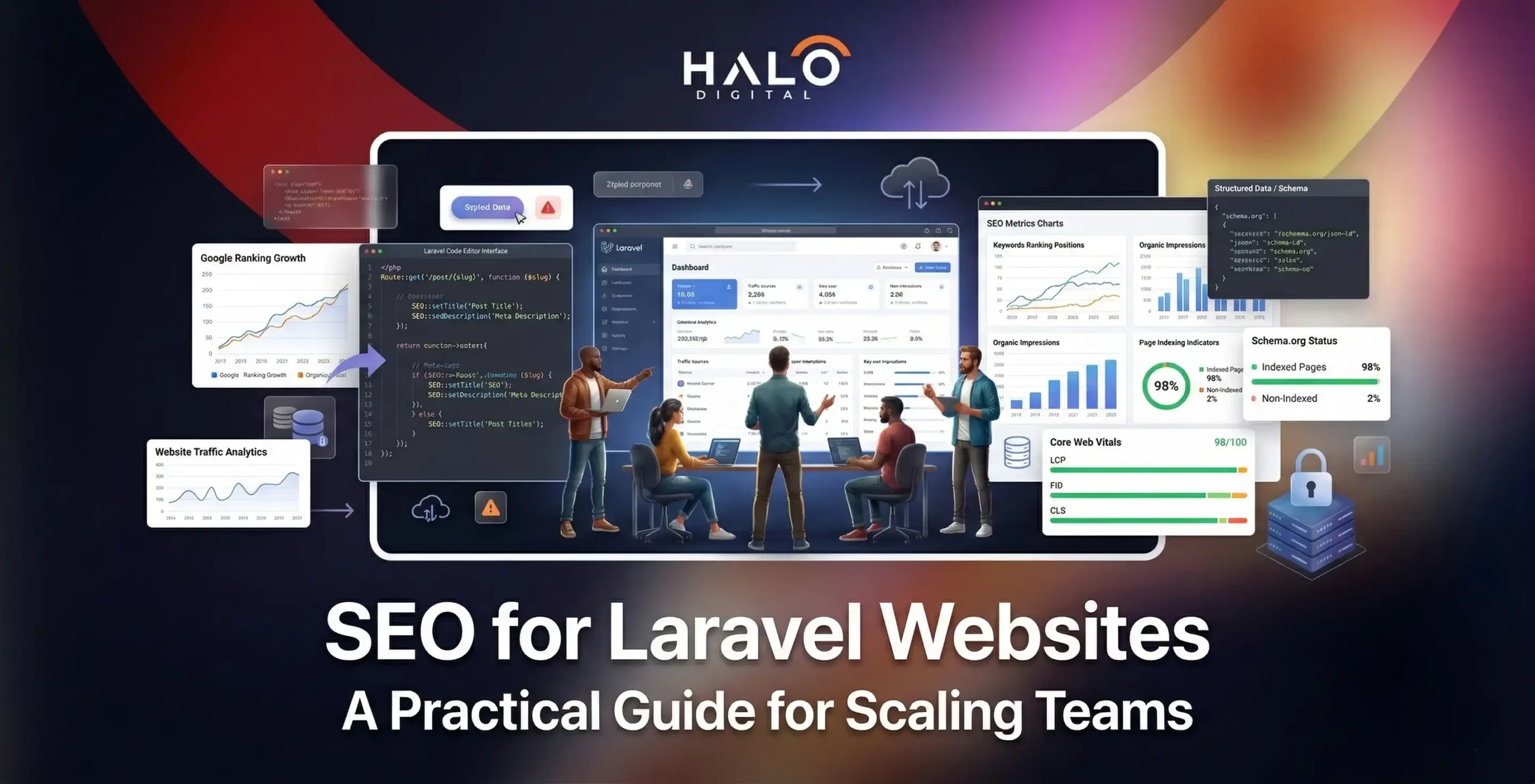
Search engine crawlers read your code, not just your visible content. This is especially true for custom builds; for instance, implementing proper SEO for Laravel applications requires specific routing, clean HTML, and rendering strategies to ensure crawlers can easily digest the dynamic content.
When your HTML uses proper semantic elements like heading tags, article tags, and nav tags, you are giving crawlers a structured map of your page.
They can distinguish the main heading from a subheading, identify your navigation from your body content, and understand what matters most on each page.
Messy code, duplicate elements, and broken HTML confuse crawlers. The result is poor indexability, meaning pages that exist on your site simply do not show up in search results.
Robots.txt files and XML sitemaps guide crawlers on which parts of your site to index and which to ignore, giving you control over how your site is represented in search.
HTTPS security via an SSL certificate is also a Google ranking factor. Any site running on HTTP in 2026 is signaling to both users and search engines that security is not a priority. This is a development decision with direct SEO consequences.
Prioritizing fundamental web application security best practices safeguards your user data while simultaneously protecting your hard-earned search rankings.
On-Page SEO Elements That Live Inside the Development Layer
On-page SEO is often presented as a content writer’s responsibility. In reality, many on-page elements are controlled at the development level and require developer involvement to implement correctly.
Title Tags and Meta Descriptions
The title tag is one of the strongest on-page SEO signals you have. It tells Google the primary topic of your page and appears as the clickable headline in search results. A well-written title tag targets a primary keyword, stays under 60 characters, and communicates clear value to the reader.
Meta descriptions do not directly affect rankings, but they influence click-through rate, which affects rankings indirectly. A compelling meta description tells users exactly what they will find on the page and why they should click. Both of these elements are coded into the page head and need to be implemented correctly at the development level.
Header Tag Hierarchy
Every page should have one H1 tag that contains the primary keyword and clearly states the page’s topic. H2 tags organize major sections, and H3 tags further break those sections into subsections. This hierarchy is not just good content structure. It is how Google reads the topical depth of your page.
When developers build page templates without SEO input, heading tags often get assigned based on visual styling rather than semantic meaning. An H1 might be used because it looks big, not because it marks the primary topic. This breaks the semantic logic that search engines rely on.
Image Alt Text and Schema Markup
Alt text on images serves two purposes. It helps visually impaired users understand what an image shows, and it gives search engines additional context about your page content. Every image on your site should have a descriptive alt attribute, ideally one that relates to the page’s topic without forced keyword stuffing.
Beyond standard images, leveraging next-gen formats like WebP and properly handling heavy media elements like background videos ensures your visually rich pages do not sacrifice core web vitals and loading speeds.
Schema markup, also called structured data, is code you add to your pages to help search engines understand the content in greater detail. It can enable rich results in Google search, such as star ratings, product prices, FAQ snippets, and event dates appearing directly in the results page. For businesses in competitive markets, rich results improve both visibility and click-through rate significantly.
At Halo Digital, we have turned complex project requirements into real revenue across 193 plus projects for startups and enterprises worldwide. The right technology and architecture decisions today become your greatest business asset tomorrow.
Why SEO and Development Need to Work Together From Day One
One of the most expensive mistakes a business can make is launching a website and then bringing in an SEO specialist afterward to fix it.
Retrofitting SEO onto a fully built site is like replumbing a house after the walls are up. It is possible, but it costs far more than planning the plumbing before construction.
Ignoring these ranking factors initially is one of the most common reasons a standard website development timeline gets derailed by endless post-launch revisions.
When SEO strategy informs development from the start, keyword research shapes the site architecture. The URL structure is clean and descriptive before a single page is built. The sitemap is logical.
Internal links are planned, not added as an afterthought. Redirects are mapped before anything is launched.
This proactive mapping prevents a frustrating user experience filled with 404 broken links, which not only spikes your bounce rate but signals to Google that your website is poorly maintained.
The result is a site that is ready to rank from day one rather than requiring months of technical cleanup before SEO work can even begin.
This integrated approach is exactly what we practiced when building DonorSync, as detailed in our DonorSync SaaS case study. The platform needed to handle high traffic, maintain strong security, and rank for competitive nonprofit sector keywords.
Because the SEO requirements were built into the development brief from the beginning, the platform launched with proper canonical tags, SEO-friendly URLs, fast load times, and a structured content architecture. The client did not need to come back months later for a technical audit.
Agencies and development teams that treat SEO as a separate deliverable are creating unnecessary cost and delay for their clients. Knowing how to choose a web development company that bakes technical SEO into their standard workflow is crucial to avoiding these expensive setbacks.
The most effective digital products are built by teams where web developers and SEO specialists share the same brief.
Generative Engine and Answer Engine Optimization in Web Development
SEO is no longer limited to traditional search engines. Generative Engine Optimization, or GEO, refers to optimizing your content and web structure so it appears in AI-generated answers from tools like Google’s AI Overviews, ChatGPT, and Perplexity. Answer Engine Optimization, or AEO, focuses specifically on structuring your content so that voice assistants and AI search tools can extract and surface direct answers.
Both GEO and AEO have significant implications for web development. For your content to be cited in AI-generated responses, it needs to be structured clearly.
FAQ sections with clean question and answer formatting, proper schema markup, clear H2 and H3 subheadings that mirror search queries, and concise paragraph answers below each heading all increase the likelihood of your content being pulled into AI answers.
From a development standpoint, this means implementing FAQ schema, HowTo schema, and Article schema where applicable.
It also means ensuring your site loads fast enough that AI crawlers do not time out before reading your content, and that your canonical tags are set correctly so the right version of your page is the one being indexed.
Businesses that position their web development strategy with GEO and AEO in mind today are building compounding search visibility that extends well beyond the traditional blue links on a results page.
SEO-Friendly URL Structure and Technical Decisions That Matter
A URL like yourwebsite.com/p?id=4821 tells Google nothing about what is on that page. A URL like yourwebsite.com/services/web-development is readable, descriptive, and keyword-relevant. URL structure is a development decision with direct SEO implications, and it is much harder to change after a site is live without triggering redirect chains or losing link equity.
Technical SEO covers a broad set of development tasks that collectively determine how search engines interact with your site.
These include creating and submitting an XML sitemap so search engines know which pages to crawl, setting up proper 301 redirects for any URLs that have changed, implementing canonical tags to prevent duplicate content issues, optimizing robots.txt to prevent crawlers from wasting budget on unimportant pages, and ensuring your site is correctly configured on HTTPS.
Duplicate content is one of the quickest ways to dilute your search rankings. When developers properly configure canonicals, they give search engines a clear directive on which version of a page is the primary source, protecting your site from algorithmic confusion.
None of these tasks require content writing. They are all developer responsibilities. But their impact on SEO performance is substantial and often determines whether months of content investment pays off or disappears into page three of search results.
Common Mistakes When SEO and Development Are Treated Separately
Having worked across hundreds of projects, we see the same patterns repeatedly when development and SEO operate in silos.
- Websites launch with no XML sitemap, meaning search engines take weeks or months to discover new pages that should have been indexed on day one.
- JavaScript-heavy single-page applications are built without server-side rendering, meaning search engines see a blank page instead of content because they cannot execute JavaScript efficiently.
- Over-reliance on client-side JS or AJAX without a progressive enhancement strategy means your most valuable dynamic content might remain completely invisible to Googlebot.
- Page templates use heading tags for visual styling, breaking the semantic hierarchy that search engines use to understand content.
- Image files are uploaded without compression, adding seconds to page load times and pushing Core Web Vitals scores into poor territory.
- URL structures are set by default CMS settings rather than designed around keyword strategy, making future changes costly.
- Sites go live on HTTP rather than HTTPS, creating both a security vulnerability and a Google ranking penalty.
Each of these mistakes is entirely preventable when development and SEO planning happen in the same conversation.
How Halo Digital Integrates SEO Into Web Development
Every project at Halo Digital begins with a discovery phase where business goals, target audience, and SEO requirements are mapped together. Before architecture is designed or wireframes are drawn, we establish the keyword strategy, define the URL structure, identify the priority pages, and set performance benchmarks.
Our developers work from briefs that include SEO specifications. Page templates are built with proper semantic HTML from the start. Schema markup is implemented during development, not added as a post-launch plugin. Performance is tested before deployment using tools like Google PageSpeed Insights and Lighthouse. And every site we deliver launches with an XML sitemap, clean canonical tags, a verified Google Search Console setup, and structured redirect mapping.
The outcome is not just a website that looks good. It is a digital product that is ready to compete in search from the moment it is live.
Building for Search Is Building for Growth
The businesses that grow consistently through organic search are not necessarily the ones with the biggest content budgets. They are the ones whose websites were built with search intent in mind. A technically sound, fast, mobile-responsive website with clean code and a logical structure gives every piece of content you publish a far better chance of ranking than even the most well-researched article sitting on a poorly built site.
SEO and website development are not competing disciplines. They are two sides of the same investment. When they are aligned, the compounding effects on organic visibility, traffic quality, and conversion rates are significant. When they are separated, businesses end up paying twice: once to build the site, and again to fix the SEO problems that were baked in from the start.
Factoring SEO requirements into your initial web development cost is always a more economical investment than paying for post-launch technical audits and extensive code rebuilds.
If your website is underperforming in search despite strong content, the answer is almost always in the development layer. And if you are building a new digital product, the best time to bring SEO into the conversation is before the first line of code is written.
At Halo Digital, we build digital products that perform from day one. If you want a website that ranks, converts, and scales, let us talk.
FAQs
Where does a web developer’s responsibility end and an SEO expert’s job begin?
Developers build the technical foundation, focusing on site speed, clean code, and server architecture. SEO experts build upon this by managing keywords, content, and resolving complex crawlability and indexing issues.
Does my SEO specialist need to communicate directly with my web developer?
Yes, absolutely. They must collaborate closely. If developers, designers, and SEOs work in silos, you risk launching a visually stunning website that search engines simply cannot crawl or understand.
What technical SEO should I expect from a standard web development agency?
A reliable agency provides a strong baseline: optimizing page speed, ensuring flawless mobile responsiveness, writing semantic HTML, and correctly configuring technical files like robots.txt and XML sitemaps before launch.
Are certain web development frameworks more SEO-friendly than others?
Traditional CMS platforms often have built-in SEO architecture. Conversely, modern JavaScript-heavy frameworks can cause severe indexing challenges unless developers properly configure server-side rendering (SSR) or progressive enhancement techniques.
Can an SEO expert fix Google Search Console issues, or do I need a developer?
SEO experts easily identify Search Console issues like indexing errors. However, fixing deeply rooted technical problems, like complex server errors or broken site architecture, requires a web developer’s expertise.
Is there a single professional who handles both complex web development and complete SEO?
While some hybrid professionals exist, true experts in both are rare. Developers focus on code and functionality, while SEOs specialize in ongoing search visibility, content strategy, and market research.

Abdullah Mangi is an SEO strategist and content writer with 5 years of experience helping businesses grow online. He writes about programming, tech, online business, and practical how-to topics. Abdullah has worked with clients in SaaS, software development, web design, link building, yacht rentals, gardening, car rentals, and recruitment.