







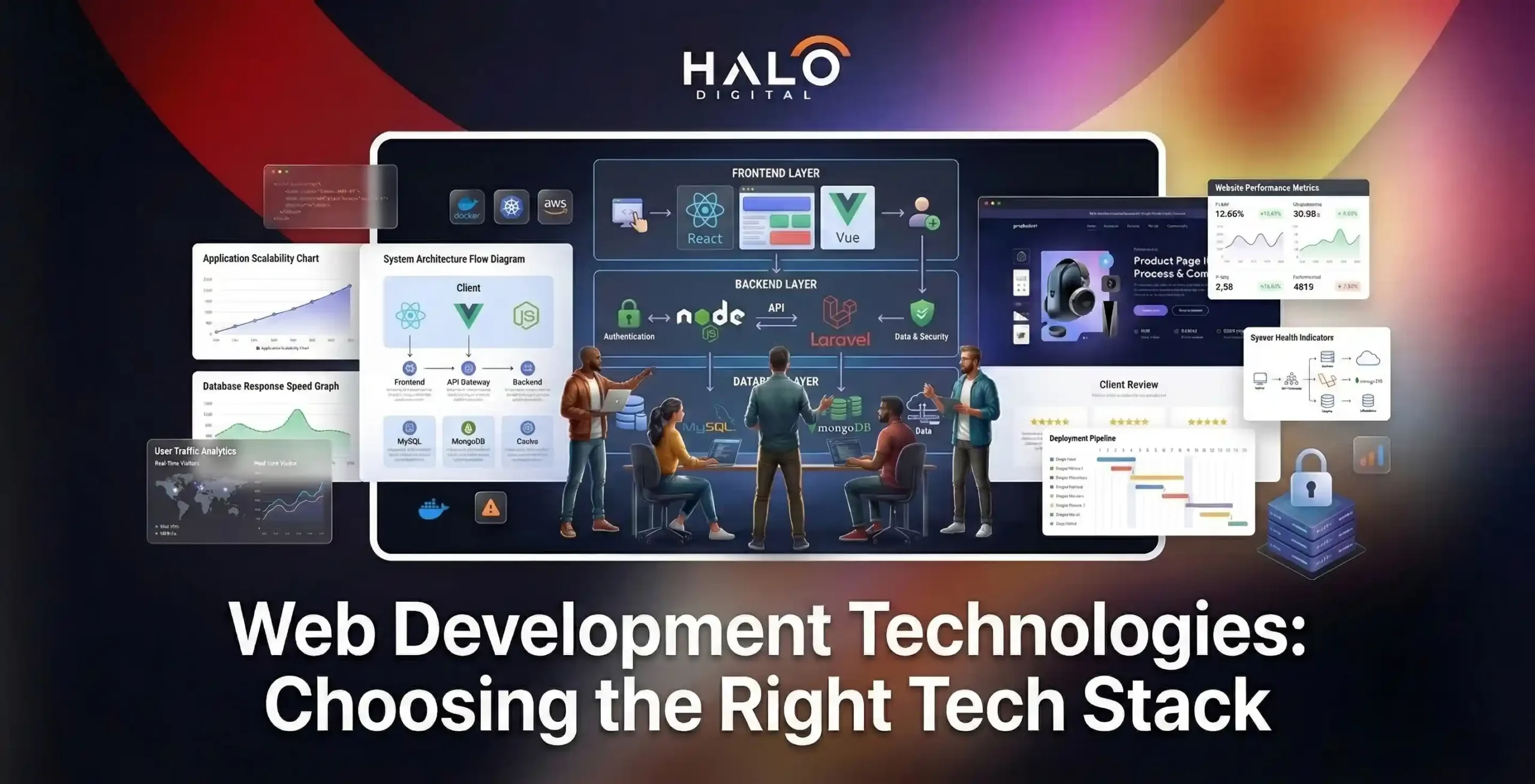
Choosing a tech stack is a crucial business decision, not just a technical one. The combination of technologies you choose determines how fast your app loads, how securely it handles data, and how much it costs to scale and maintain.
Frontend (What users see):
React: Best for high-growth SaaS and dynamic apps.
Vue.js: Best for fast MVPs and simple integration.
Angular: Best for massive, structured enterprise platforms.
Backend (The engine & logic):
Node.js: Best for real-time apps and live dashboards.
Laravel (PHP): Best for content-heavy sites and secure SaaS workflows.
Python (Django): Best for AI, machine learning, and data analytics.
Ruby on Rails: Best for building rapid MVPs for startups.
Databases (Where data lives):
SQL (MySQL/PostgreSQL): For structured, strict data (like finance).
NoSQL (MongoDB): For flexible, evolving content.
Redis: For high-speed caching and real-time performance.
Top Stack Combinations in 2026:
MERN Stack: The go-to for modern SaaS and social platforms.
LAMP Stack: Highly stable and cost-effective (powers most CMS sites).
Python Stack: The standard for AI and data-driven products.
The Golden Rule: Don’t pick a technology just because it’s trendy or because a single developer prefers it. Make your decision based on your core product requirements, long-term scalability, budget, and the availability of developers to maintain the code in the future.
Every digital product begins with a decision that most business owners do not fully realize they are making. Before a single page is designed, before a logo is placed, before a single button is coded, someone chooses the technology that will power everything.
That choice shapes how fast your website loads, how well it scales, how secure it is, and ultimately how much it costs to build and maintain.
Web development technologies are the programming languages, frameworks, libraries, databases, and infrastructure tools that developers combine to build functional, high-performing digital products.
Choosing the right combination is not a developer-only conversation. It is a business decision with long-term consequences for your growth, your budget, and your competitive position.
This guide was written for startup founders, business owners, and enterprise decision makers who want a clear, honest understanding of what goes into a modern tech stack for web development, and how to make the right call for their specific situation.
What Is a Tech Stack and Why Does It Matter for Your Business
A tech stack is the full combination of tools and technologies used to build and run a web application. Think of it as the architecture of your digital product. The decisions made here determine everything from how quickly your development team can ship features to how smoothly your platform handles ten users or ten million.
A well-chosen stack lets your platform grow with your business without requiring a complete rebuild. A poorly chosen one creates what engineers call technical debt: a backlog of problems that slow you down, drive up costs, and hold your product back from scaling.
For business owners and founders, understanding the basics of web development technologies does not mean learning to code. It means being able to have an informed conversation with your development partner, understand the trade-offs being made, and protect your investment from the start.
Every tech stack has two core layers. The client side, which is everything a user sees and interacts with in their browser, and the server side, which handles data processing, business logic, storage, and security behind the scenes. Both layers matter equally, and the decisions made in each one affect the other.
Frontend Technologies: The Layer Your Users Experience
Technology | Ideal Business Profile | Time-to-Market | Scalability & Maintenance | Key Business Advantage |
React | High-growth SaaS, Marketplaces, Dynamic Web Apps | Fast to Moderate | Highly scalable; easy to maintain due to reusable components. | Massive global talent pool; backed by Meta. |
Vue.js | Early-stage startups, MVPs, Upgrading legacy systems | Very Fast | Highly flexible; lowest maintenance overhead. | Cost-effective development; seamless integration into existing projects. |
Angular | Large enterprises, Complex internal tools, Dashboards | Moderate to Slow | Built for massive, structured enterprise scale. | Strict code consistency and high security; backed by Google. |
Frontend technologies build the visible surface of your digital product. Every button, navigation menu, animation, form, and layout your users interact with is produced by frontend code. The quality of this layer directly affects user experience, session duration, conversion rates, and SEO performance.
Getting frontend development right means more than making something look good. It means building something that loads fast across devices, responds intuitively to user actions, and communicates your brand with clarity. Here are the most widely used frontend tools in 2026 and when each one makes sense.
React
React is the most widely adopted frontend library in the world, maintained by Meta. It builds interfaces using reusable components, meaning your development team writes a piece of UI once and reuses it across the entire application. This dramatically reduces build time and makes future updates more efficient.
React is the right choice for products with complex user interfaces, real-time data updates, and large-scale applications that will grow over time. Platforms like Airbnb, Netflix, and Uber rely on React for their frontend. If you are building a SaaS platform, a marketplace, or a product with a rich dashboard experience, React is consistently the strongest option.
Vue.js
Vue.js offers a lighter and more approachable alternative to React. It is particularly well-suited for teams that want fast development cycles without a steep technical learning curve. Vue.js is flexible and integrates smoothly with existing projects, making it a strong choice for businesses upgrading an older platform rather than building from scratch.
At Halo Digital, we use Vue.js in projects where speed of delivery and simplicity of maintenance are the primary goals. It powers clean, fast interfaces without the overhead of a heavier framework.
Angular
Angular is a full frontend framework maintained by Google. Unlike React and Vue.js, Angular comes with a more opinionated structure and includes more built-in functionality out of the box. It is best suited for large enterprise applications where teams need consistent code standards, strong typing through TypeScript, and a predictable architecture across a large codebase.
The trade-off is that Angular has a steeper learning curve and can be heavier for smaller applications. For enterprise teams building complex internal platforms, Angular’s structure is a genuine advantage.
HTML5, CSS3, and JavaScript
These are the foundational web development technologies that every frontend framework is built on top of. HTML5 provides page structure, CSS3 controls visual presentation, and JavaScript adds interactivity. No matter which framework your development team uses, these three remain the underlying building blocks of every web experience.
Backend Technologies: The Engine Powering Your Platform
Technology | Primary Language | Ideal Use Case |
Node.js | JavaScript | Real-time apps (messaging, live dashboards) |
Laravel | PHP | Content-heavy platforms, SaaS, financial workflows |
Django | Python | AI integration, data analytics, machine learning |
Ruby on Rails | Ruby | Rapid MVP development for early-stage startups |
The backend is where the real work happens. It processes user requests, enforces business logic, handles authentication, manages data, connects third-party services, and ensures your platform remains secure and reliable under load. When your platform crashes during a traffic spike, that is usually a backend problem. When sensitive customer data is exposed, that is almost always a backend failure.
Choosing the right backend technology stack for web development is one of the highest-stakes decisions in any project. Here is how the major options compare.
Node.js
Node.js allows developers to write server-side code in JavaScript, the same language used on the frontend. This unification of languages across the full stack speeds up development and makes it easier to build and maintain teams. Node.js is event-driven and non-blocking, which makes it extremely efficient for applications that handle many concurrent connections.
It is an excellent choice for real-time applications such as messaging platforms, live dashboards, notification systems, and APIs that need to handle high volumes of simultaneous requests. The Pilgrim App backend, which serves users across peak pilgrimage seasons with real-time features, was built on a Node.js-compatible architecture running on AWS for exactly this reason.
Laravel and PHP
Laravel is a PHP-based backend framework that has become the standard for building robust web applications quickly and securely. PHP powers a significant portion of the web, and Laravel brings structure, security, and developer productivity to that foundation.
Laravel is particularly well-suited for content-heavy platforms, SaaS products, and applications that require strong database relationships, built-in authentication, and a rich ecosystem of packages.
Because of its clean routing and templating architecture, it is also highly effective for executing advanced technical SEO for Laravel strategies.” Why: You have a dedicated page for Laravel SEO. Mentioning it in the Laravel section captures readers who are specifically concerned about their web app’s future search visibility.
DonorSync, the charity donation management platform built by Halo Digital, was developed on Laravel because of its reliability, security controls, and efficient handling of complex financial workflows.
Python and Django
Python is the dominant language for data-intensive applications, machine learning, and AI-powered products. Django is Python’s most widely used web framework, providing a secure, scalable, and well-documented foundation for building complex platforms.
If your product involves data processing, analytics, AI integration, or machine learning functionality, Python is the natural backend choice. It also has one of the most active developer communities in the world, which means better long-term support and access to a wide talent pool.
Ruby on Rails
Ruby on Rails is a mature backend framework known for enabling rapid development. It follows a convention-over-configuration philosophy, which means experienced Rails developers can build and ship features very quickly. It is a strong choice for startups that need to move fast in early stages and for platforms where development speed is a higher priority than raw performance at scale.
Database Technologies: Where Your Data Lives
Database Type | Examples | Best For | Data Structure |
Relational (SQL) | MySQL, PostgreSQL | Financial platforms, user management | Structured tables |
NoSQL | MongoDB | Content platforms, evolving data | Flexible documents |
In-Memory | Redis | Caching, high-speed real-time data | Key-value pairs |
Databases are the memory of your application. They store user accounts, transaction records, content, configurations, and every piece of operational data your platform depends on. The choice between database types has significant implications for how your platform performs at scale and how easily it can evolve over time.
MySQL and PostgreSQL
These are relational databases that organize data into structured tables with defined relationships between them. They use SQL to query and manage data and are ideal for applications where data integrity, consistency, and complex relationships matter most. Financial platforms, user management systems, and any product handling transactional data are strong candidates for relational databases. MySQL powers much of the internet including WordPress-based platforms, while PostgreSQL is often preferred for applications requiring more advanced data operations.
MongoDB
MongoDB is a NoSQL database that stores data as flexible documents rather than structured tables. This makes it highly adaptable for applications where data structures evolve over time or vary significantly between records. It is a natural fit for content platforms, product catalogs, and applications that need to handle large volumes of unstructured or semi-structured data efficiently.
Redis
Redis is an in-memory database used primarily for caching, session management, and real-time data operations. It is not typically a primary database but works alongside relational or NoSQL databases to make applications significantly faster by storing frequently accessed data in memory rather than repeatedly querying a slower database. The Pilgrim App uses Redis as part of its backend architecture to maintain fast response times under heavy usage during pilgrimage seasons.
The Most Reliable Tech Stack Combinations in 2026
Tech Stack | Components | Primary Benefit | Common Applications |
MERN | MongoDB, Express, React, Node.js | Single language (JS) across full stack | Modern SaaS, social platforms |
MEAN | MongoDB, Express, Angular, Node.js | Strong architecture and type safety | Large enterprise codebases |
LAMP | Linux, Apache, MySQL, PHP | Highly stable and cost-efficient | CMS platforms, marketing sites |
Python | Python (Django/FastAPI), React/Vue | Excellent for data processing | AI-powered products, analytics |
In practice, most successful web products use a proven combination of the tools above rather than building from entirely custom choices. Here are the most widely used and trusted stack combinations in 2026.
MERN Stack
MongoDB, Express.js, React, and Node.js form a fully JavaScript-based stack that allows development teams to work in a single language across both frontend and backend. MERN is the most commonly used stack for modern SaaS products, social platforms, and applications that need rapid development cycles with real-time capabilities. It is the stack of choice for many funded startups building their first scalable product.
MEAN Stack
MEAN replaces React with Angular in the same combination, giving teams a more structured and opinionated frontend. This makes it a better fit for enterprise teams with large codebases that benefit from Angular’s strict architecture. The TypeScript foundation throughout the entire stack adds type safety that reduces bugs in production.
LAMP Stack
Linux, Apache, MySQL, and PHP is a battle-tested combination that powers an enormous portion of the web including most WordPress-based platforms. It remains a reliable choice for content-heavy sites, marketing websites, and CMS-driven platforms where stability, developer availability, and cost efficiency are priorities.
Python Stack
Django or FastAPI on the backend paired with React or Vue.js on the frontend is the preferred combination for data-driven applications, AI-integrated platforms, and analytics products. This stack is increasingly popular as businesses integrate machine learning and intelligent features into their core product offerings.
Before writing a single line of code, make sure your technology choices support scalability, performance, and long-term growth.
How to Choose the Right Web Development Technologies for Your Project
The right technology stack is not the most advanced one or the most popular one. It is the one that fits your product requirements, your team’s capabilities, your timeline, and your long-term growth plan. Here is how to think through that decision without getting lost in technical complexity.
Start With Your Core Product Requirements
Before any technology conversation begins, define what your product needs to do. Does it require real-time data updates? Will it handle high volumes of concurrent users? Does it need AI or machine learning capabilities? Will it integrate with payment systems, third-party APIs, or external data sources? These functional requirements narrow down your choices significantly. A real-time messaging feature points toward Node.js. A data analytics dashboard points toward Python. A content-driven marketing site points toward the LAMP stack.
Think About Scalability From the Start
One of the most expensive mistakes in web development is choosing a stack that works at launch but fails to scale as your user base grows. The right stack supports horizontal scaling, meaning you can add capacity by distributing load across additional servers rather than endlessly upgrading a single machine. Cloud-native stacks built around containerization with Docker and orchestration with tools like Kubernetes are the modern standard for products designed to scale. Build for where you expect to be in three years, not just where you are today.
Consider Your Team and Hiring Pipeline
The best technology in the world delivers nothing if you cannot find developers who know how to use it. JavaScript, Python, and PHP have the largest global developer communities, which means broader talent availability, faster onboarding, and more affordable hiring. Niche or highly specialized technologies may offer performance advantages but create real bottlenecks when you need to scale your team or replace a developer.
Security and Compliance Requirements
If your product handles sensitive data including financial information, health records, or personal user data, your technology choices must support strong security controls. Frameworks like Django and Laravel have mature, well-tested security features built in. Your stack should support HTTPS enforcement, encrypted data storage, authentication standards, and compliance with regulations like GDPR where applicable. Security is not something you add to a platform after launch. It needs to be built into the architecture from the start.
Budget and Long-Term Maintenance Cost
Open-source technologies like those powering the MERN, LAMP, and Python stacks carry no licensing fees, which reduces initial cost significantly. However, the total cost of ownership includes hosting infrastructure, developer salaries, ongoing maintenance, and the cost of any future rebuilds if a poor technology choice requires replacing. Choosing a widely supported and well-documented stack keeps these long-term costs predictable and manageable.
Common Technology Choices That Cost Businesses Later
After delivering more than 193 projects for clients across the US, UK, and UAE, certain patterns emerge in the projects where businesses run into avoidable problems.
- Choosing a frontend JavaScript framework for an application that does not need it adds unnecessary complexity and slows down development without adding meaningful value for users.
- Building on a technology stack purely because a developer is comfortable with it rather than because it fits the product requirements creates long-term architectural problems.
- Ignoring mobile responsiveness at the architecture level rather than treating it as a core requirement from the start results in poor SEO performance and a broken user experience on the devices most of your audience uses.
- Not planning for database scalability early means costly migrations later when your data volume outgrows the initial setup.
- Skipping caching infrastructure like Redis until performance becomes a visible problem means your users experience slowdowns that damage retention before you get around to fixing them.
- Choosing a niche or outdated backend language to save on initial development cost often results in higher long-term maintenance expenses and a limited hiring pool when you need to scale your team.
Working With a Professional Web Development Company like Halo Digital
Understanding web development technologies gives you the foundation to make smarter decisions. But knowing which stack is right for your specific product, your team, your timeline, and your budget requires experience that comes from building real platforms at scale.
Halo Digital, a professional website development company USA, partners with startups, enterprises, and mission-driven organizations to build digital products that are engineered for performance, security, and long-term growth. From SaaS platforms to mobile applications to enterprise web systems, our team combines technical depth with strategic clarity to deliver products that work in the real world.
If you are planning a new product or evaluating your existing technology infrastructure, we would welcome the conversation. Our team works with clients across the United States and globally, and we offer a free consultation to help you map the right technology strategy before a single line of code is written.
Conclusion
Web development technologies are not purely a developer’s concern. They are the foundation of every business decision you will make about your digital product for years to come.
Choosing the right frontend framework determines how fast your users can interact with your platform. Choosing the right backend shapes how securely and efficiently your data is processed.
Selecting the right database affects how your platform handles growth. And choosing the right overall stack determines how expensive and painful your future will be as your business scales.
The businesses that build the best digital products are not the ones with the biggest budgets. They are the ones who start with clarity: about what they need to build, why they are building it, and which technology decisions will support their goals over the long term.
If you are about to start a new project or revisit an existing platform, the most valuable investment you can make before development begins is a clear technology strategy. Get that right, and everything else becomes significantly more manageable.
FAQs
What are web development technologies?
Web development technologies are the programming languages, frameworks, libraries, databases, and infrastructure tools that developers use to build and operate websites and web applications. They are organized into frontend tools that handle what users see, backend tools that manage data and logic, and database systems that store information.
How do I choose the right tech stack for my web project?
Start by defining your core product requirements: what the application needs to do, who will use it, and how many users you expect to serve. Then evaluate your timeline, budget, and the availability of developers who work with your preferred technologies. Finally, consider your long-term scalability needs. A good technology partner can guide you through this process and help you avoid expensive mistakes.
What is the difference between frontend and backend technologies?
Frontend technologies build the part of your application that users see and interact with directly in their browser. Backend technologies handle the server side of your application: processing requests, managing databases, enforcing business logic, and maintaining security. Both layers work together to create a functioning digital product.
Which tech stack is best for a SaaS product in 2026?
For most SaaS products, the MERN stack (MongoDB, Express.js, React, Node.js) remains one of the strongest choices because it supports real-time functionality, scales well, and benefits from a large developer community. For data-intensive SaaS products with AI requirements, a Python backend paired with a React or Vue.js frontend is increasingly common.
Does the tech stack affect SEO?
Yes, significantly. Page load speed, mobile responsiveness, server-side rendering capability, and clean HTML output are all influenced by your technology choices. A poorly configured JavaScript-heavy frontend can produce pages that search engines struggle to index. Choosing the right stack and configuring it correctly for SEO from the start makes a substantial difference in organic search performance.
How much does the choice of tech stack affect development cost?
The tech stack affects development cost both immediately and over time. Open-source technologies carry no licensing fees. Widely used frameworks have larger talent pools, which keeps developer rates competitive. Stacks with strong documentation and large communities reduce time spent on troubleshooting. Poor stack choices lead to technical debt that makes future changes slow and expensive.
Do I need to understand web development technologies to work with a development agency?
You do not need deep technical knowledge, but a basic understanding of how tech stacks work helps you ask better questions, evaluate proposals more confidently, and protect your investment from early architectural mistakes. A reliable development partner will always explain their technology recommendations in plain business terms and help you understand the trade-offs before any decisions are made.

Arsalan Chauhdary is the CEO and Co-Founder of Halo Digital, a full-spectrum software development agency serving startups and enterprises globally. Over the past 10 years, he has led the architecture and development of platforms used by millions of people across 160+ countries, including DonorSync (GDPR-compliant charity SaaS), Pilgrim (faith-based mobile app with 50K+ users), and enterprise portals for multinational organizations. His work has been referenced by Cloudways and published on Creately. Arsalan Tariq specializes in Laravel, AWS, and building secure, scalable systems for regulated industries including healthcare, finance, and nonprofits. At Halo Digital, he leads a multidisciplinary team focused on delivering products that prioritize security, compliance, and long-term impact.