


- An app development NDA legally protects your idea, source code, designs, and business strategy from being copied, reused, or disclosed when working with developers, designers, investors, or partners
- Choosing the correct NDA type such as unilateral, mutual, or multilateral is essential depending on who is sharing confidential information during the app development process
- A strong NDA must clearly define confidential information, usage limitations, duration, remedies for breach, and post termination obligations to remain enforceable
- NDAs support but do not replace intellectual property protections like copyrights and patents and are most effective when signed before sharing wireframes, prototypes, or source code
- Poorly drafted NDAs often fail in court especially in cross border development making legal customization and jurisdiction clauses critical
Launching a mobile app begins with sharing your idea with developers, designers and potential partners but that early stage is also when most ideas are exposed to the highest risk.
Founders often reveal business logic, user flows, technical architecture and monetization plans long before any legal protection is in place. That gap is where misuse copying and IP disputes typically start.
A non disclosure agreement for app development exists to close that gap. It creates a legally enforceable obligation that prevents anyone you share your app concept with from disclosing reusing or exploiting it outside your project.
When drafted correctly an NDA protects not only your idea but also your source code designs technical documentation and business strategy.
Based on years of working with startups agencies and enterprise development teams this guide explains exactly how app development NDAs work when they are legally effective, what clauses matter most and how to use them at each stage of the app development lifecycle.
You will learn how to protect your app idea before hiring developers during outsourcing and while collaborating with multiple partners so your intellectual property remains secure from concept to launch.
What Is a Non-Disclosure Agreement (NDA)?
A non disclosure agreement is a legally binding contract used to protect confidential information shared between two or more parties during a business relationship. In app development this typically includes the app idea source code designs technical architecture user flows and business strategy.
When one party discloses sensitive information the NDA legally restricts the receiving party from disclosing, using or repurposing that information outside the agreed scope. This obligation applies whether the information is shared verbally in documents or through digital assets.
In practical terms an NDA allows founders to discuss their app concept openly with developers, designers, and investors while maintaining legal control over how that information can be used. In this guide the terms non disclosure agreement NDA and app idea confidentiality agreement all refer to this same legal mechanism within the context of app and software development.
Types of NDAs (Unilateral, Mutual, Multilateral)
There are three common types of NDAs. Choosing the right type ensures clarity on who owes duty to whom. Too broad or the wrong type can make enforcement weak.
- Unilateral NDA: Only one party (you) discloses information, and the other party promises to keep it secret. Use this when you are the sole idea owner and only sharing with a developer or contractor.
- Mutual NDA (also “bilateral”): Both sides may share confidential info and both promise secrecy. Useful if your developer or partner also reveals proprietary methods or modules.
- Multilateral NDA: Three or more parties involved, some or all sharing info. Instead of multiple bilateral NDAs, one multilateral can cover all. This helps when multiple contractors, stakeholders, or third parties work together under one umbrella.
How NDAs Differ from Other Legal Protections (IP, Patents, Copyrights)
An app development NDA complements IP protections. It gives you a contract remedy, while IP gives you statutory rights. In my work, I always pair an NDA with clear ownership clauses in the app development contract agreement to cover all angles.
It’s easy to conflate NDAs with patent, trademark, or copyright protection, but they differ
- Patents protect inventions or processes, often requiring public disclosure. NDAs let you keep things secret while developing, before you patent or formalize.
- Copyright protects original works like code, design, and graphics. But copyright alone doesn’t stop someone you shared code with from reusing it. An NDA gives you contractual recourse if they breach.
- Trademarks protect brand names and logos and are not relevant to your internal idea or code.
Why You Need an NDA in App Development
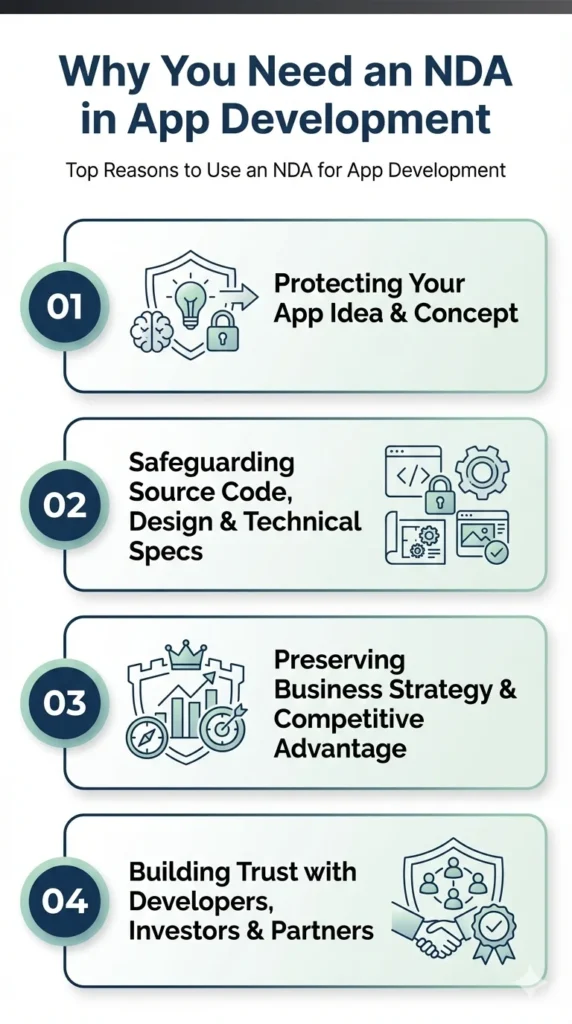
The short answer is that without the protection of law, your ideas, strategy, and even code are at risk. You may share wireframes, business models, or architecture before you sign up as a developer. An NDA creates boundaries. It displays sincerity. helps build confidence and prevents misuse.
Below are the top reasons why you should use an NDA for both desktop and mobile app development.
Protecting Your Idea and Concept
The concept of your app may appear simple, but your functions and user flows, along with your USP (unique selling feature), provide benefit. If someone discovers your concept first, but the prototype isn’t available, they might take it up, tweak it, or present it in other places. An NDA will help safeguard your idea prior to obtaining market evidence.
I once had a conversation with an entrepreneur who had shared the idea with three agencies. Two agencies walked away, and one of them quietly reused key flow. With no app idea confidentiality agreement, the creator had no legal recourse.
Safeguarding Source Code, Design & Technical Specifications
When you share your prototypes, wireframes, modules, APIs, and even backend architecture, you are exposing your technology and logic. A solid NDA assures that everything is “confidential information.”
It restricts the developer from reusing your module in different projects. It restricts the use of your modules to only your own project, not for sale or reuse by third parties.
Preserving Business Strategy & Competitive Advantage
The app’s plan of action, revenue model, and overall web application development cost structure are all business secrets. You shouldn’t allow your developer or any third party to reuse your approach elsewhere. A strong NDA ensures the security of both business and technical disclosures.
This is the reason I include a clause addressing the business and technical aspects to ensure that nothing gets lost through an unintended loophole.
Building Trust with Developers, Investors & Partners
Affirming an NDA indicates that you’re taking the confidentiality of your work seriously. It provides peace of mind to the developers, knowing that their work won’t be disclosed. In the same way, investors and partners are accustomed to confidentiality when they look over the results or plans for the future. This is especially true in custom software development for startups, where the core idea is the primary asset.
An NDA builds trust, increases the security of conversations, and helps you establish relationships more securely.
At Halo Digital, we make sure your NDA has all the important factors covered and your security is ensured.
When to Use an NDA During the App Development Lifecycle
Timing matters when it comes to protecting your app idea. An NDA should be in place before any sensitive information is shared. The sections below explain how and when to use an NDA throughout the app development lifecycle.
Before Initial Discussions or Pitching Your Idea
A high-level pitch or teaser could be at risk of leakage. Use a lightweight NDA or a mutual NDA to secure your information before sharing your thoughts. It’s not possible to share code in the near future; however, the pitch deck, market research, and special features need protection.
During Hiring of Designers, Developers, or Contractors
During the process of choosing a mobile app development company and before granting them any assignment, ask them to take the time to agree on an NDA for software developers or an NDA for mobile app development.
This way you’ll be able to safely provide them non-critical details and demand proof of their work or request their input without the fear of them escaping and creating a clone.
Before Sharing Detailed Wireframes, Prototypes or Code
When you have moved beyond thoughts into architecture and design, the risk and value increase. You should only share your ideas once the NDA is signed. At this point it is recommended to add NDA clauses for app development that cover codes, UI web designs, APIs, and naming conventions. Also, you should include a database, and more.
When Outsourcing or Working with Multiple Parties
If you contract out modules or integrate with APIs from third parties or have multiple contractors, things get complicated. Make use of an inter-lateral NDA or ensure that each company has its own NDA. Also, consider how data flows between them.
If one party leaks, the chain of liability must be clear. I always map dependencies in the NDA to avoid backdoor leaks.
Essential Components of a Strong NDA for App Development
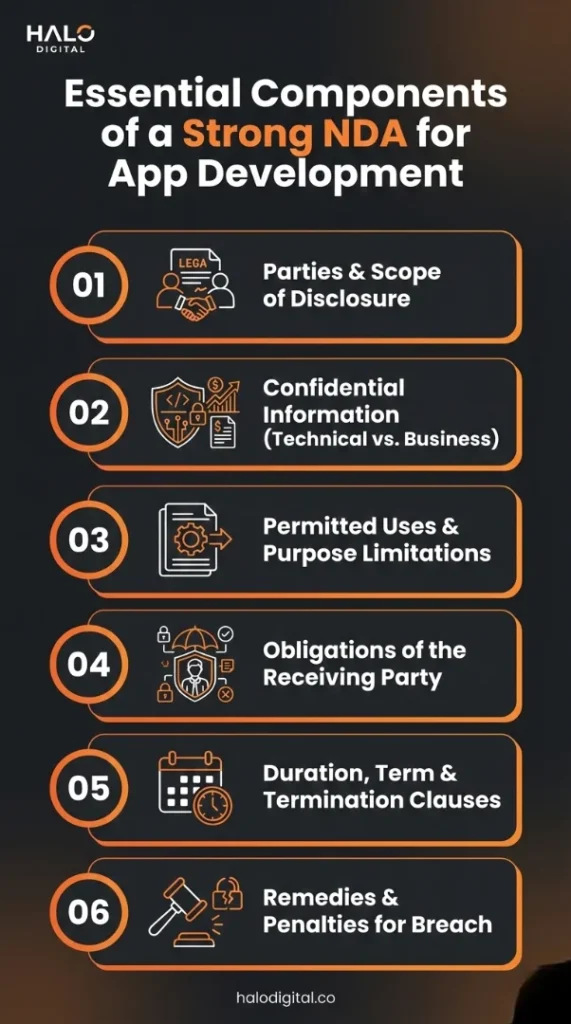
A solid NDA will be much more than just a “keep it secret” sentence. It should be precise as well as balanced and enforceable.
Parties & Scope of Disclosure
The NDA must identify who is the disclosing party and who is the receiving party. If you work via a parent company or through multiple stakeholders, name them all. Also define scope: which individuals, teams, and contractors are bound. Don’t leave ambiguous roles.
What Constitutes “Confidential Information”—Technical vs. Business Info
Define what constitutes “confidential.” That may include:
- Modules, algorithms, source code
- System architecture, APIs
- UI/UX designs, wireframes, mockups
- Pricing, business plans, marketing, road maps
- Data models, analytics, user data
Also include that derivatives, summaries, or notes are also covered. However, they should not be covered by common knowledge or information that the recipient already knew about. This helps to avoid obligations that are too broad that courts could decide to reject.
Permitted Uses & Purpose Limitations
Inform the receiver that they are allowed to use the confidential information only in connection with the project (e.g., “developing the app for the disclosing party”). They aren’t able to reverse engineer it or reuse it in other projects. This means they can’t repackage your concept.
Obligations of the Receiving Party
This is a crucial section. This ensures that confidentiality is maintained in practice and not only in theory.
- Obligation to keep confidential information
- Limit access to the internal network to only those with a “need to know.”
- Make use of security measures (encryption passwords, encryption, restricted access)
- Obligation to notify you in the event that there is a breach or unauthorized access occurs.
- Retrieve or destroy data when the project has ended
Duration, Term & Termination Clauses
Be careful: some jurisdictions disfavor infinite or overly long duration. Courts may refuse enforcement if they see the term as unfair. How long does the NDA last? You may want:
- A term during development
- A post-project confidentiality period (e.g. 2 to 5 years)
- Conditions for termination
- A clause that obligations survive termination
Remedies & Penalties for Breach
Inappropriate or harsh penalties could deter developers and could be ruled invalid by the courts. It is important to strike a balance.
- Rights to Injunction (so that you are able to stop any leaks instantly)
- Damages in liquidation or monetary damages
- Indemnity for loss
- The right to pursue legal action
What NDAs Can't Do: Limitations and Common Misconceptions
An NDA is a powerful legal tool but it has clear limitations. Understanding what an NDA can and cannot protect helps you avoid false assumptions and reduces the risk of legal or operational disputes later.
The challenge of Protecting Ideas Alone (without implementation)
Courts frequently say that concepts or ideas alone aren’t protected. Without design, code, or even implementation, a concept is too ambiguous.
An NDA assists when information is given, but you have to demonstrate actual intent rather than only an idea. If you simply say to anyone, “I want a delivery app,” it may not be enforceable.
Enforceability Issues (Overly Broad or Vague Terms)
If your NDA is unclear (“all confidential information will remain private always”) or is excessively weighty, a court could decide that it is unenforceable.
If you do not clear the terms of confidentiality of items, obligations, or their duration, judges could decide to void specific parts or even the entirety. This is why the drafting process is important to be cautious about.
International/Cross-Border Complications
If your developer is located overseas, the laws of that country may differ. Courts are not able to take your jurisdiction’s decision into consideration. You’ll need:
- Choice of law/governing law clause
- Dispute resolution (arbitration, mediation)
- Local enforcement
Despite all this, the difficulty of obtaining damages or enforcing injunctions that cross boundaries is a challenge.
Publicly Known Information & Prior Knowledge
You can’t limit what’s already available in the public domain or even what the receiver already has in mind. If a developer can show they knew similar information prior to signing, they could be exempt from responsibility. Make sure you make sure to include exemptions such as “prior knowledge” and “public domain.” If not, you’re extending your reach.
Mistakes to Avoid When Drafting or Signing an NDA
A poor NDA is far more damaging than no NDA at all. Beware of these common pitfalls.
Using Generic Templates Without Customization
Downloading an unspecific “NDA template PDF” and signing it can be risky. It could not be compatible with your area of jurisdiction and scope or project. There are templates that do not include crucial clauses or have undefined definitions. Always make sure you are able to adjust your template to the app development NDA and your particular project.
Setting Unreasonable Penalties or Terms That Scare Off Developers
If your terms are excessively restrictive, like lifetime bans and massive liquidated damages, you could turn off developers who are qualified. They could refuse to sign. Even more, courts can dismiss clauses as inconvenient. Find a balance to ensure that the NDA is both fair and protective.
Failing to Define Confidential Information Clearly
If you don’t clarify the meaning of “confidential,” you leave out gaps. Developers could assert “that wasn’t included” and keep their liability to a minimum. Be sure to list the categories and attach appendices, schedules, or other documents when needed.
Neglecting to Address What Happens After Termination
Many NDAs stop at the project’s end but forget to declare what happens next. Who destroys materials? Who continues obligations? How long do obligations survive? What about derivative works? You must cover these, or leakage happens post-termination.
How to Draft & Negotiate an NDA That Works
Making an NDA is one thing, but making sure that it is usable in actual situations is another. It must be in accordance with the local regulations and have clearly defined requirements with the developers. Here’s how to do it right.
Work with Legal Counsel vs. DIY/Template Approach
Templates online appear simple; however, they don’t always meet your requirements. A lawyer’s involvement ensures the NDA matches your location as well as the type of app and disclosure range. My experience is that the right app development contract agreement saves your company from future disputes.
Tailoring the NDA to Your Region/Jurisdiction (Local Laws)
Different nations and different countries interpret NDAs differently. For instance, some restrict the length of confidentiality, while others reject harsh penalties. Be sure to mention the law that governs and the place of jurisdiction in disputes. Local counsel may modify clauses to ensure that they are enforceable when both parties have an interest.
Negotiation Tips with Developers/Agents
Developers might be hesitant to sign an NDA. Be sure to approach negotiations with a sense of transparency. Make it clear that the goal is to protect the parties, but not to control them. Simple language, clear definitions of what’s covered, and reassurance that the developers’ credit and ownership remain equitable. This respect for one another builds long-lasting relations.
Ensuring Practical Security Measures (Access Control, Information Sharing)
A signed NDA does not mean much without actions. Make sure that only authorized individuals have access to sensitive information; secure information with passwords or secure drives. You can also keep track of the sharing of files. I recommend that founders keep the “confidential file log” so that no sensitive files go without being tracked.
Conclusion
Protection of your app’s idea begins even before you begin coding. A properly drafted nondisclosure agreement for app development protects your creative ideas as well as your data and business strategy. It establishes expectations, creates confidence, and safeguards your intellectual assets from being misused.
If you’re involved with freelancers or companies or investors, ensure that NDAs are an integral element of your workflow. Through my many years of working with digital projects, I’ve witnessed one thing repeated. Strong agreements result in solid partnerships and fewer regrets.
Halo Digital: Your Trusted Partner from Concept to Launch
A strong NDA is the first step in protecting your vision. The next is finding a development partner you can trust with that vision. At Halo Digital, our foundation is built on deep expertise and a commitment to transparent partnership.
Established Leadership and Foundational Expertise
Halo Digital was established by Arsalan Tariq and Noman Akhter. Their vision was to bridge the gap between complex technology and strategic business needs.
- EEAT Focus: Our leadership team brings years of industry experience to every project. I personally ensure that our development process focuses on real-world, measurable outcomes, not just code.
- Our Mission: To empower clients with only the best technology services and the agility to succeed.
Full-Stack Services: Beyond Just Coding
We offer comprehensive services, ensuring you have one trusted partner for the entire process; from the idea you just protected to the final launch.
- Software Development: Building efficient, secure, and scalable backends and enterprise solutions.
- App Development: Native (iOS, Android) and cross-platform (Flutter, React Native) expertise.
- Web App Development: Creating powerful, modern web applications using frameworks like Laravel.
- Web Design: Crafting intuitive UI/UX designs that provide a seamless user experience.
- Cloud & DevOps: We specialize in secure, scalable cloud deployment on AWS and Firebase, preventing future scaling issues.
Proven Success with High-Performing Projects
Our portfolio demonstrates our capability to handle complex, real-world challenges—the very kind of ideas that demand a strong NDA.
- Pilgrim App: A high-engagement spiritual platform requiring AI integration and custom content delivery. This showcases our ability to handle specialized, complex requirements.
- DonorSync: A great fundraising management tool. This project highlighted our security and data expertise for enterprise solutions.
- Unscripted: A demanding e-commerce and booking platform. It required high traffic management and seamless payment integration.
Focused on Innovation, Scalability, and Measurable Business Growth
We believe a great application must solve a real business problem. Our process is designed for maximum ROI.
- Innovation: We use the latest tools to give you the best products. This helps your applications continue beating the competitors in the long run.
- Scalability: Every solution we build is cloud-native, designed to handle millions of users from day one.
- Growth: We integrate analytics and performance tracking. We help you measure success post-launch.
Tailored Solutions for Complex Industries
Our insight is a key differentiator. We have deep experience in sectors requiring high-grade security, data privacy, and complex compliance adherence. We build solutions that aren’t just functional, but also secure and efficient.
FAQs
How long should NDA protections last?
Most NDAs last 2–5 years after the project ends. For trade secrets or sensitive algorithms, you can extend the term. However, permanent NDAs are rarely enforceable in court.
Can I enforce an NDA if the developer is overseas?
Yes, but it’s complex. Add governing law and arbitration clauses. Even then, enforcing it abroad depends on local courts and treaties. Always verify jurisdiction before hiring overseas teams.
Does signing an NDA guarantee my idea won’t be stolen?
No agreement can stop bad actors completely, but it gives you a legal foundation. An NDA discourages misuse and provides a clear right to sue if a breach occurs.
What costs are involved in drafting or implementing an NDA?
Lawyer-drafted NDAs cost between $150 and $500 on average. Templates are cheaper but riskier. If you’re outsourcing development, the investment in legal review is minor compared to potential losses.

Abdullah Mangi is an SEO strategist and content writer with 5 years of experience helping businesses grow online. He writes about programming, tech, online business, and practical how-to topics. Abdullah has worked with clients in SaaS, software development, web design, link building, yacht rentals, gardening, car rentals, and recruitment.