








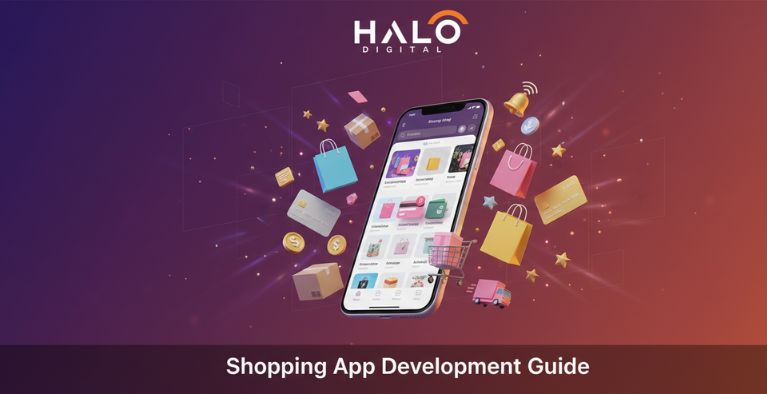
Market Overview: Mobile shopping drives 59% of US e-commerce ($925B in 2023, projected $1.4T by 2027). Apps outperform mobile websites with 3x higher retention and 62% better conversion rates.
Development Costs:
- MVP: $80K-$120K (4-6 months)
- Standard: $100K-$200K (6-8 months)
- Advanced (AI/AR): $200K-$400K (10-14 months)
Essential Features: User authentication, product catalog with search, shopping cart, checkout, payment integration (Stripe/PayPal), order tracking, push notifications, admin dashboard.
Technology Stack: React Native (cross-platform saves 30-40% vs native), Node.js backend, PostgreSQL/MongoDB databases, AWS cloud, Stripe payments.
Industry-Specific Costs:
- Fashion/Apparel: $100K-$200K (AR try-on reduces 40% returns)
- Grocery/Delivery: $150K-$350K (complex logistics)
- Healthcare/Pharmacy: $180K-$400K (HIPAA compliance adds 40-60%)
- Furniture: $120K-$280K (AR visualization)
- Electronics: $100K-$220K (comparison tools)
2026 Trends: AI personalization ($25K-$60K), AR virtual try-on ($40K-$80K), live shopping ($60K-$120K), BNPL integration ($8K-$15K), zero-party data collection ($12K-$25K).
ROI Expectations:
- Year 1: 5-20% of revenue from app
- Year 2: 20-35% of revenue
- Year 3: 30-50% of revenue
- Typical breakeven: 12-24 months
Build If You Have: >$1M annual revenue, 5K+ active customers, repeat-purchase products, $100K+ budget, $20K-$50K marketing allocation.
Don’t Build If: <$500K revenue, no existing customers, <$80K budget, one-time purchase products, no marketing budget.
Ongoing Costs: 15-20% annual maintenance, cloud hosting $300-$3K/month, payment processing 2.9% + $0.30/transaction.
Key Success Metrics: CAC <$40, browse-to-purchase rate 2-4%, Day 30 retention >10%, LTV >3x CAC, cart abandonment <70%.
Mobile shopping drives 59% of US e-commerce sales, reaching $925 billion in 2023 and growing toward $1.4 trillion by 2027. Yet building a successful shopping app requires more than copying Amazon’s playbook. It demands strategic feature selection, realistic budgeting ($80K-$250K depending on complexity), and technical expertise in cross-platform development.
This guide provides actionable insights from real projects at Halo Digital, covering exact cost breakdowns, technology decisions, development timelines, and ROI expectations. Whether you’re a Tampa retailer or national brand, you’ll learn how to launch an app that serves customers while meeting business objectives. Let’s explore the development landscape with honest, data-backed guidance.
The US Shopping App Market in 2026
The mobile commerce landscape continues its explosive growth trajectory. Statista reports that mobile shopping now accounts for approximately 59% of total US e-commerce sales, with the market reaching $925 billion in 2023. Industry analysts project this figure will climb to $1.4 trillion by 2027, representing a compound annual growth rate of approximately 11%.
This growth is driven by over 218 million Americans who regularly purchase products through mobile applications. The shift from desktop to mobile represents more than just a change in device preference. It signals a fundamental transformation in consumer behavior, where convenience, speed, and accessibility determine which brands capture market share.
Market Size and Growth Trajectory
The expansion of mobile commerce reflects several converging factors. Improved mobile payment infrastructure, faster cellular networks, and sophisticated app development frameworks have eliminated many technical barriers that once made mobile shopping cumbersome. Consumers now expect the same seamless experience on their phones that they previously associated only with desktop computers.
Year | Mobile Commerce Revenue | Growth Rate | Percentage of Total E-commerce |
2023 | $925 billion | 12.3% | 59% |
2024 | $1.03 trillion | 11.4% | 62% |
2026 | $1.28 trillion | 11.8% | 67% |
2027 | $1.4 trillion | 9.4% | 69% |
These projections account for both existing retailers expanding mobile capabilities and new entrants launching app-first business models. The data suggests that by 2027, nearly 70% of all online retail transactions will occur through mobile devices.
Why Mobile Apps Outperform Mobile Websites
Despite responsive web design advances, native and cross-platform mobile applications deliver measurably superior results across key performance metrics. Research from Apptentive indicates that mobile apps maintain retention rates approximately three times higher than mobile websites over a 90-day period.
The performance gap stems from several technical and psychological factors:
Push Notification Impact: Applications with enabled push notifications see engagement rates 88% higher than those relying solely on email or SMS communication. This direct communication channel allows retailers to re-engage customers with personalized offers, abandoned cart reminders, and time-sensitive promotions.
Conversion Rate Advantages: Mobile applications consistently convert browsers into buyers at higher rates than mobile web experiences. The ability to save payment information securely, enable biometric authentication, and reduce checkout friction contributes to conversion rate improvements ranging from 20% to 40% depending on product category and implementation quality.
Performance and Reliability: Native applications cache essential data locally, enabling faster load times and offline functionality. Users experience immediate visual feedback, smoother animations, and more responsive interfaces compared to mobile web alternatives that depend entirely on network connectivity.
Metric | Mobile App | Mobile Website | Improvement |
90-Day Retention | 28% | 9% | 211% higher |
Average Session Length | 5.2 minutes | 2.8 minutes | 86% higher |
Conversion Rate | 3.4% | 2.1% | 62% higher |
Pages per Session | 8.7 | 5.3 | 64% higher |
These performance differentials translate directly into revenue impact. A retailer generating $10 million annually through mobile web could potentially increase that figure to $14-16 million by migrating users to a well-executed mobile application.
Success Stories From Major Retailers
Several national retailers have publicly shared results from their mobile app investments, providing concrete benchmarks for what successful implementation can achieve.
Walmart’s Mobile Commerce Growth: Walmart’s mobile application now drives a substantial portion of the company’s digital revenue. While the company doesn’t disclose exact figures, SEC filings indicate that e-commerce represents over $80 billion in annual sales, with mobile applications accounting for the majority of digital transactions. The app’s click-and-collect functionality alone serves millions of orders monthly.
Target’s Drive Up Feature: Target introduced its Drive Up curbside pickup feature exclusively through its mobile application. According to Target’s annual report, this feature contributed to significant same-day service growth, with millions of customers using the app for in-store and curbside pickup. The company reports that app users spend approximately 20% more than non-app customers annually.
Nike’s Direct-to-Consumer Strategy: Nike’s investment in its mobile application exemplifies how brands can reduce dependence on third-party marketplaces. The company’s fiscal 2023 earnings showed that digital sales through owned channels, including the Nike app, represent over 25% of total revenue. App users receive exclusive access to limited releases, personalized product recommendations, and early access to sales events.
Our work with e-commerce clients at Halo Digital mirrors these patterns. We developed Boost, a Shopify-powered platform delivering tech and lifestyle products globally. The implementation focused on performance optimization and scalable backend architecture, resulting in measurable improvements in customer engagement and transaction completion rates.
Determining If Your Business Needs a Shopping App
Not every retail business benefits equally from mobile app development. The investment makes strategic sense when specific conditions align with your business model and growth objectives.
Consider developing a shopping application if your business meets these criteria:
Revenue Threshold: Annual revenue exceeding $1 million indicates sufficient transaction volume to justify development costs and ongoing maintenance. Businesses below this threshold often achieve better ROI by optimizing their mobile web experience first.
Customer Base Characteristics: An established customer base of at least 5,000-10,000 active buyers provides the critical mass needed for app adoption. Existing customers familiar with your brand convert to app users more readily than acquiring entirely new customers through the app.
Product and Purchase Patterns: Businesses selling products with high repeat purchase rates see faster ROI from app development. Grocery retailers, subscription services, and consumable goods benefit most from the convenience and reminder capabilities that apps provide.
Brand Differentiation: Unique products, strong brand identity, or specialized expertise justify the investment in a proprietary platform. Commodity products available through multiple retailers face steeper challenges differentiating through an app alone.
Financial Readiness: Budget allocation of $100,000 or more for initial development, plus 15-20% annually for maintenance and updates, represents realistic investment levels. Underfunded projects frequently fail to deliver competitive user experiences.
Technical Infrastructure: Existing systems for inventory management, payment processing, and order fulfillment must be mature enough to integrate with mobile platforms. Apps amplify both strengths and weaknesses in backend operations.
Business Characteristic | Favorable for App | Unfavorable for App |
Annual Revenue | >$1M | <$500K |
Active Customers | 5,000+ | <1,000 |
Purchase Frequency | Weekly/Monthly | Once yearly |
Product Availability | Exclusive/Unique | Commodity/Generic |
Development Budget | $100K+ | <$50K |
Marketing Budget | $20K+ launch | No dedicated budget |
Technical Infrastructure | Integrated systems | Manual processes |
Businesses considering app development should honestly assess their position across these dimensions. Meeting four or five of the favorable criteria suggests strong potential for success. Meeting two or fewer indicates that alternative digital investments might deliver better returns.
Types of Shopping Apps: Which Model Fits Your Business?
Selecting the appropriate application architecture requires understanding how different models serve distinct business needs, customer expectations, and operational capabilities. Each model carries specific technical requirements, development costs, and implementation timelines that significantly impact project scope and budget.
Marketplace Applications
Marketplace platforms connect multiple independent sellers with buyers through a unified interface. This model mirrors traditional shopping malls but operates entirely through digital infrastructure.
Amazon and eBay pioneered this approach, creating environments where thousands of vendors list products while the platform manages discovery, transactions, and trust mechanisms. Building a marketplace requires substantially more development effort than single-vendor applications due to the complexity of managing multiple stakeholder relationships.
Specification | Details |
Business Model | Multi-vendor platform with commission-based revenue |
Technical Complexity | Very High (5/5) |
Development Cost | $200,000 to $500,000 |
Development Timeline | 10 to 14 months |
Ideal For | Platforms connecting diverse sellers with buyers |
Revenue Model | Transaction fees (8-15%), listing fees, premium placements |
Core Features Required:
Vendor management dashboards enable sellers to create profiles, upload products, manage inventory, process orders, and track earnings. Each vendor operates semi-independently while the platform maintains quality standards and customer experience consistency.
Commission calculation engines automatically compute platform fees based on transaction values, product categories, and vendor tier structures. These systems must handle complex scenarios including refunds, partial returns, and promotional pricing.
Dispute resolution workflows provide structured processes for handling conflicts between buyers and sellers. Effective systems balance fairness with operational efficiency, often incorporating multiple escalation levels and automated mediation for common scenarios.
Search and discovery algorithms surface relevant products from thousands or millions of listings based on user queries, browsing history, and behavioral patterns. The quality of these algorithms directly impacts conversion rates and user satisfaction.
Technical Architecture Considerations:
Microservices architecture separates vendor management, payment processing, search functionality, and order fulfillment into independent services that communicate through well-defined APIs. This approach enables teams to develop and deploy features independently while maintaining system stability.
Scalable infrastructure must handle dramatic fluctuations in traffic, particularly during promotional events or seasonal peaks. Cloud platforms like AWS or Google Cloud provide the elasticity needed to scale resources automatically based on demand.
Multi-tenant database design isolates vendor data while maintaining performance and security. Careful schema design prevents data leakage between vendors while enabling platform-level analytics and reporting.
The complexity and cost of marketplace development put this model beyond reach for most small to medium businesses. Companies pursuing this approach typically have secured significant funding or possess existing platform infrastructure they can extend.
Brand Direct-to-Consumer Applications
Single-brand applications eliminate marketplace intermediaries, giving retailers complete control over customer experience, data, and profit margins. Nike, Warby Parker, and Glossier exemplify successful implementations of this model.
Specification | Details |
Business Model | Single brand selling directly to customers |
Technical Complexity | Medium (3/5) |
Development Cost | $80,000 to $200,000 |
Development Timeline | 5 to 8 months |
Ideal For | Established brands with loyal customer bases |
Revenue Model | Direct product sales with full margin capture |
Core Features Required:
Loyalty program integration rewards repeat purchases through points, tiers, or exclusive access. Successful programs increase customer lifetime value by 25-40% according to industry research, making them essential for brands focused on retention.
Exclusive product releases and early access create urgency and reinforce the value of downloading the brand’s app rather than shopping through third-party marketplaces. Limited edition products and member-only sales drive app adoption.
Personalized shopping experiences leverage customer data to surface relevant products, sizes, and styles based on purchase history and browsing behavior. Personalization engines can increase conversion rates by 15-30% compared to generic product displays.
Customer relationship management integration ensures that data collected through the app enhances marketing efforts across all channels. Email campaigns, retargeting ads, and customer service interactions benefit from unified customer profiles.
Technical Requirements:
Integration with existing inventory management systems ensures real-time stock accuracy across all sales channels. Overselling creates customer service nightmares and damages brand reputation.
CRM platform connectivity enables marketing teams to leverage app behavior data for segmentation, personalization, and lifecycle marketing. Popular CRMs include Salesforce, HubSpot, and Klaviyo.
Content management capabilities allow marketing teams to update promotions, featured products, and seasonal campaigns without requiring developer involvement for each change.
We built a direct-to-consumer platform for a regional fashion retailer with five physical stores in Florida. The project focused on integrating their existing point-of-sale system with mobile ordering and click-and-collect functionality. Within 12 months, the app drove 18% of total revenue while increasing average order value by 22% compared to website transactions.
Multi-Brand Retail Applications
Large retailers operating both physical locations and online channels use apps to create seamless omnichannel experiences. Walmart and Target represent the gold standard for this model, offering features like store-specific inventory checks, curbside pickup, and loyalty programs that work across digital and physical touchpoints.
Specification | Details |
Business Model | Retail chain with multiple product categories |
Technical Complexity | High (4/5) |
Development Cost | $150,000 to $400,000 |
Development Timeline | 8 to 12 months |
Ideal For | Retail chains with physical locations expanding digitally |
Revenue Model | Direct sales plus increased store traffic |
Core Features Required:
Store locator with real-time inventory displays which locations stock specific products, reducing wasted trips and improving conversion rates. Accuracy is critical as incorrect stock information destroys trust.
Curbside pickup coordination allows customers to notify stores of arrival, triggering order preparation and delivery to parking spaces. This feature became table stakes during the pandemic and remains popular for time-constrained shoppers.
Omnichannel inventory management synchronizes stock levels across warehouses, distribution centers, and individual stores. Customers can purchase products for home delivery, store pickup, or ship-from-store options depending on availability and preference.
Barcode scanning enables in-store price checks, product information lookup, and self-checkout functionality. These features bridge physical and digital shopping experiences.
Technical Requirements:
Point-of-sale system integration connects mobile applications with in-store transaction systems, enabling features like mobile payment, digital receipts, and real-time inventory updates.
Location services infrastructure supports geofencing for parking lot arrival notifications, proximity-based promotions, and store-specific content delivery.
Enterprise resource planning connectivity ensures that the mobile app accesses the same authoritative inventory, pricing, and customer data that powers other business systems.
The complexity of integrating multiple backend systems makes this model suitable primarily for established retailers with dedicated IT resources and significant budgets.
Grocery and Essentials Delivery Applications
On-demand grocery delivery represents one of the most technically challenging application categories due to logistics complexity, perishable product handling, and time-sensitive delivery requirements. Instacart and Amazon Fresh demonstrate that execution difficulty correlates with market opportunity.
Specification | Details |
Business Model | On-demand delivery with personal shoppers or automated fulfillment |
Technical Complexity | Very High (5/5) |
Development Cost | $200,000 to $500,000 |
Development Timeline | 10 to 16 months |
Ideal For | Grocery retailers and quick commerce operations |
Revenue Model | Delivery fees, service charges, markup on products |
Core Features Required:
Real-time inventory management accounts for rapid stock depletion as multiple shoppers fulfill orders simultaneously. Systems must reserve products during order processing to prevent overselling.
Delivery time slot booking allows customers to select preferred delivery windows while enabling operations teams to optimize driver routes and capacity utilization.
Substitution handling provides shoppers with approved alternatives when requested products are unavailable. Smart substitution engines suggest comparable products based on customer preferences and order history.
Perishable product management includes temperature tracking, expiration date monitoring, and specialized handling instructions for dairy, frozen, and fresh food categories.
Technical Architecture:
Logistics optimization algorithms route drivers efficiently while considering factors like traffic patterns, delivery windows, order priority, and vehicle capacity constraints.
Driver companion applications provide turn-by-turn navigation, customer communication tools, delivery proof collection, and real-time order updates.
Route planning engines continuously reoptimize delivery sequences as new orders arrive and traffic conditions change throughout the day.
The operational complexity and thin margins characteristic of grocery delivery make this model viable primarily for well-capitalized businesses with strong operational expertise.
Fashion Resale Applications
Peer-to-peer fashion marketplaces enable individuals to sell secondhand clothing and accessories directly to other consumers. Poshmark and ThredUp built substantial businesses by creating trusted environments for used fashion commerce.
Specification | Details |
Business Model | Peer-to-peer marketplace for secondhand fashion |
Technical Complexity | Medium-High (4/5) |
Development Cost | $120,000 to $300,000 |
Development Timeline | 7 to 10 months |
Ideal For | Sustainable fashion platforms and resale marketplaces |
Revenue Model | Transaction fees, shipping labels, authentication services |
Core Features Required:
Social selling features allow sellers to build followings, share listings across social networks, and create curated storefronts that reflect personal style.
Authentication services verify the legitimacy of luxury items, protecting buyers from counterfeit products while enabling sellers to command premium prices for authentic goods.
Shipping label generation and prepaid postage simplify logistics for sellers who may lack experience with e-commerce fulfillment.
Payment escrow systems hold funds until buyers confirm receipt and satisfaction, reducing fraud risk and building trust in peer-to-peer transactions.
Technical Considerations:
Image recognition tools help identify brands, estimate conditions, and suggest pricing based on comparable sales. These features reduce seller effort while improving listing quality.
Machine learning algorithms detect fraudulent listings, inappropriate content, and suspicious user behavior patterns that might indicate scams or policy violations.
The sustainability focus and community aspects of resale platforms attract environmentally conscious consumers, creating opportunities for brands that authentically embrace circular economy principles.
Live Shopping Applications
Live shopping combines video streaming, real-time interaction, and instant purchasing to recreate QVC-style television shopping for the mobile generation. Whatnot achieved a $3.7 billion valuation by applying this model to collectibles, demonstrating the format’s commercial viability.
Specification | Details |
Business Model | Livestream auctions and real-time sales events |
Technical Complexity | Very High (5/5) |
Development Cost | $250,000 to $600,000 |
Development Timeline | 12 to 18 months |
Ideal For | Collectibles, limited editions, influencer-driven sales |
Revenue Model | Platform fees (8-12%), premium placement, subscriptions |
Core Features Required:
Real-time video streaming infrastructure delivers high-quality video to thousands of simultaneous viewers with minimal latency. Content delivery networks and adaptive bitrate streaming ensure smooth playback across varying network conditions.
Interactive chat functionality enables viewers to ask questions, interact with sellers, and participate in the community atmosphere that makes live shopping engaging.
Bidding systems manage auction mechanics including bid increments, automatic bidding, countdown timers, and winner notifications.
Payment processing handles the unique challenges of auction-style commerce where final prices remain unknown until bidding concludes and multiple transactions must process simultaneously when auctions end.
Technical Architecture:
WebRTC protocols enable low-latency video streaming suitable for real-time interaction. Alternative solutions include custom RTMP implementations or third-party streaming platforms.
Content delivery networks distribute video streams globally while minimizing bandwidth costs and latency for viewers regardless of geographic location.
Real-time databases synchronize bid information, chat messages, and viewer counts across thousands of connected clients without creating bottlenecks or race conditions.
The technical sophistication and infrastructure costs associated with live shopping make this model appropriate primarily for well-funded startups or established platforms adding live features to existing applications.
Understanding these six models provides the foundation for aligning business objectives with technical architecture. Most businesses fit clearly into one category, though hybrid approaches combining elements from multiple models are becoming increasingly common as the market matures.
HALO Digital is the perfect partner to transform your retail vision into a high-performing shopping app. We specialize in e-commerce solutions with proven expertise in AI recommendations, AR try-on, payment integration, and scalable architecture that drives real ROI.
Shopping App Development Cost: Complete Budget Breakdown
Understanding development costs represents one of the most critical decisions in the shopping app development process. Unlike consumer-facing marketing materials that provide vague ranges, this section breaks down actual costs based on real projects, team compositions, and feature implementations.
Cost transparency enables realistic budget planning and helps businesses avoid the common trap of underestimating total investment. Many projects fail not because of technical challenges but because initial budgets covered only development while ignoring hosting, maintenance, marketing, and operational expenses.
Cost By Application Complexity
Development costs vary dramatically based on feature scope, technical sophistication, and integration requirements. The table below categorizes applications into four complexity tiers with corresponding timelines and investment levels.
Complexity Level | Feature Count | Development Timeline | Cost Range |
Basic MVP | 8 to 10 core features | 3 to 5 months | $60,000 to $100,000 |
Standard Application | 15 to 20 features | 6 to 8 months | $100,000 to $200,000 |
Advanced Application | 25+ features with AI or AR | 10 to 14 months | $200,000 to $400,000 |
Enterprise Solution | Custom architecture with complex integrations | 12 to 18 months | $400,000 to $800,000+ |
Basic MVP Applications include only essential e-commerce functionality: user registration, product browsing, shopping cart, checkout, payment processing, order history, and basic push notifications. This tier suits businesses validating market demand or launching with limited budgets.
Standard Applications add features that enhance user experience and increase conversion rates: wishlists, product reviews, loyalty programs, social sharing, size guides, and improved search filtering. Most retail businesses launching their first shopping app fall into this category.
Advanced Applications incorporate artificial intelligence for personalized recommendations, augmented reality for virtual try-ons, live streaming capabilities, or sophisticated inventory management across multiple locations. These features differentiate premium apps from commodity alternatives.
Enterprise Solutions require custom architecture, extensive third-party integrations, multi-region deployment, advanced security protocols, and custom administrative tools. Large retail chains and marketplace platforms typically operate at this level.
Platform Development Costs
Platform selection significantly impacts both initial development costs and long-term maintenance expenses. Each approach offers distinct advantages and tradeoffs.
Platform Approach | Development Cost | Timeline | Best Use Case |
Native iOS Only | $70,000 to $150,000 | 4 to 6 months | Premium brands with iOS-dominant customers |
Native Android Only | $70,000 to $150,000 | 4 to 6 months | Markets with strong Android adoption |
Dual Native (iOS + Android) | $140,000 to $300,000 | 8 to 12 months | Maximum performance requirements |
Cross-Platform (React Native) | $80,000 to $180,000 | 5 to 8 months | Most businesses balancing cost and quality |
Progressive Web App | $40,000 to $80,000 | 3 to 5 months | Testing market fit before native investment |
Native Development delivers optimal performance and full access to platform-specific features. Choose this approach when building applications with sophisticated camera integration, advanced animation requirements, or cutting-edge platform features. The cost premium of 40-60% over cross-platform alternatives makes sense only when specific technical requirements justify the investment.
Cross-Platform Development using React Native or Flutter enables sharing 70-80% of code between iOS and Android versions while maintaining near-native performance. This approach reduces development time by 30-40% and simplifies maintenance since bug fixes and feature updates apply to both platforms simultaneously. Most retail businesses achieve excellent results with this approach.
Progressive Web Apps function through mobile browsers without requiring app store distribution. While PWAs cost significantly less to develop, they lack push notification support on iOS, cannot access certain device hardware, and deliver inferior performance compared to native applications. Consider PWAs for market validation or as complements to native apps rather than replacements.
We typically recommend cross-platform development for shopping applications unless specific requirements necessitate native approaches. The cost savings enable businesses to invest in better design, more robust testing, or enhanced marketing efforts that drive user acquisition.
Feature-Level Cost Breakdown
Breaking down costs by individual features provides transparency and enables informed prioritization decisions. The estimates below reflect mid-level developer rates and assume clean integration with modern technology stacks.
Feature | Development Time | Cost Range | Included Components |
Product Catalog | 3 to 4 weeks | $10,000 to $18,000 | Search, filtering, categories, product cards |
Shopping Cart & Checkout | 3 to 4 weeks | $12,000 to $20,000 | Cart management, promo codes, tax calculation, address validation |
Payment Integration | 2 to 3 weeks | $8,000 to $15,000 | Stripe, PayPal, Apple Pay, Google Pay |
User Authentication | 2 weeks | $6,000 to $10,000 | Social login, email verification, password recovery |
Push Notifications | 1 week | $3,000 to $5,000 | Firebase Cloud Messaging, Apple Push Notification Service |
Order Tracking | 2 weeks | $6,000 to $12,000 | Real-time status updates, delivery notifications |
Wishlist & Favorites | 1 week | $3,000 to $6,000 | Save items, share lists, stock alerts |
Reviews & Ratings | 2 weeks | $5,000 to $10,000 | Rating submission, moderation, helpful voting |
AI Recommendations | 4 to 6 weeks | $25,000 to $50,000 | Machine learning models, personalization engine, A/B testing |
AR Virtual Try-On | 6 to 8 weeks | $40,000 to $80,000 | 3D modeling, camera integration, realistic rendering |
Live Shopping | 8 to 12 weeks | $60,000 to $120,000 | Video streaming (WebRTC), real-time chat, bidding system |
Admin Dashboard | 4 to 5 weeks | $15,000 to $30,000 | Analytics, inventory management, order processing |
These estimates assume integration with established third-party services rather than building custom solutions. For example, payment processing costs assume Stripe or PayPal integration. Building proprietary payment infrastructure would increase costs by $50,000 to $150,000 while introducing significant regulatory complexity.
The healthcare app development cost analysis provides additional context for projects requiring regulatory compliance and enhanced security measures, which increase feature development costs by 25-40%.
Team Composition and Hourly Rates
Shopping app development requires coordinated work from multiple specialists. Understanding team composition and associated costs helps evaluate proposals from development agencies and plan budgets accurately.
US-Based Development Team (Tampa and Florida Rates):
Role | Hourly Rate | Typical Project Allocation |
Project Manager | $120 to $150 | 20% time commitment |
UI/UX Designer | $100 to $130 | 30% time commitment |
iOS Developer | $140 to $180 | Full-time for native, part-time for cross-platform |
Android Developer | $140 to $180 | Full-time for native, part-time for cross-platform |
Backend Developer | $140 to $180 | Full-time |
QA Engineer | $80 to $120 | 50% time commitment |
DevOps Engineer | $130 to $160 | 20% time commitment |
Standard Six-Month Project Team Breakdown:
Team Member | Time Allocation | Cost Range |
Project Manager (20% time) | 1 person, part-time | $14,000 to $18,000 |
UI/UX Designer (30% time) | 1 person, part-time | $18,000 to $23,000 |
Developers (100% time) | 2 people, full-time | $168,000 to $216,000 |
QA Engineer (50% time) | 1 person, part-time | $24,000 to $36,000 |
DevOps Engineer (20% time) | 1 person, part-time | $16,000 to $19,000 |
Project Total | $240,000 to $312,000 |
This team composition represents an upper-mid-range shopping application with standard features and moderate complexity. Basic MVP projects require smaller teams and shorter timelines, reducing costs to the $80,000 to $120,000 range.
Geographic location significantly impacts rates. Tampa and Florida offer competitive pricing compared to Silicon Valley or New York while maintaining high technical expertise. Offshore development teams charge $30 to $60 per hour but often require more management oversight and deliver inconsistent quality.
At Halo Digital, we structure teams based on project requirements rather than following rigid formulas. Simple applications might require only two developers and a designer working part-time over four months. Complex platforms might need six specialists collaborating full-time for a year. We provide detailed team compositions during the discovery phase after understanding specific requirements.
The cost to build an MVP app generally falls between these brackets. Most startups we work with land in the medium range. This budget allows for a robust backend and a polished user interface.
Simple vs Medium vs Complex MVP Costs
A simple MVP might just be a basic interface with standard features. Think of a to-do list app or a simple content reader. These are quick to build. A medium MVP involves more logic. This could include user profiles, payment gateways, and basic API integrations. A complex MVP requires advanced tech. This includes real-time streaming, complex algorithms, or heavy data processing.
Startup vs Enterprise MVP Budget Comparison
Startups are often bootstrapping. They need to be extremely lean. Their budget is usually tight, hovering around the $30,000 mark. Enterprises are different. They have larger budgets but higher compliance requirements. An enterprise MVP might need advanced security audits and legacy system integration. This naturally drives the price up, even for an MVP.
Hidden Costs and Ongoing Expenses
Development costs represent only part of total investment. Ongoing operational expenses, often overlooked during initial budgeting, can substantially impact long-term viability.
Annual Operating Costs:
Expense Category | Monthly Cost | Annual Cost | Notes |
App Store Fees | $8.25 to $8.33 | $99 (Apple) + $25 (Google one-time) | Required for distribution |
Cloud Hosting (AWS/Azure) | $300 to $3,000 | $3,600 to $36,000 | Scales with traffic and data storage |
Payment Processing | Variable | 2.9% + $0.30 per transaction | Paid to Stripe, PayPal, or similar |
SMS/Email Services | $50 to $500 | $600 to $6,000 | Transactional messages and notifications |
Push Notification Service | $0 to $500 | $0 to $6,000 | Free for Firebase with reasonable volume |
Content Delivery Network | $100 to $1,000 | $1,200 to $12,000 | Image and video delivery |
SSL Certificates | $0 to $17 | $0 to $200 | Free options available through Let’s Encrypt |
Security & Monitoring | $100 to $500 | $1,200 to $6,000 | Error tracking, performance monitoring |
First-Year Additional Investments:
Beyond monthly operating costs, budget for these significant first-year expenses:
Maintenance and Updates: Plan for 15-20% of initial development cost annually. A $150,000 application requires $22,500 to $30,000 yearly for bug fixes, security patches, operating system compatibility updates, and minor feature improvements.
Marketing and User Acquisition: Successful launches require substantial marketing investment. Budget 20-30% of development costs for initial marketing campaigns. A $150,000 app should allocate $30,000 to $45,000 for launch marketing across paid advertising, influencer partnerships, public relations, and promotional offers.
Our experience with Boost, an e-commerce platform, demonstrated that adequate marketing budget proved as important as technical execution in achieving adoption targets.
Cost Optimization Strategies
Strategic planning can significantly reduce development costs without sacrificing quality or user experience.
Minimum Viable Product Approach:
Starting with core features enables faster market entry and validates product-market fit before investing in advanced capabilities. An MVP typically includes:
- User registration and authentication
- Product browsing and search
- Shopping cart functionality
- Checkout and payment processing
- Order history and tracking
- Basic push notifications
- Simple admin dashboard
This focused scope reduces development time from 8-10 months to 4-5 months and cuts costs by 30-40%. After launch, analyze user behavior and feedback to prioritize feature additions based on actual needs rather than assumptions.
We followed this approach with DonorSync, our donation management platform, launching with essential features first then expanding based on charity feedback and usage patterns.
Cross-Platform Development Benefits:
Selecting React Native or Flutter instead of native iOS and Android development typically saves 30-35% in costs while maintaining quality. A dual native project costing $280,000 might cost $180,000 to $200,000 using cross-platform frameworks.
Additional benefits include:
- Single codebase simplifies maintenance
- Feature updates deploy simultaneously to both platforms
- Smaller team required, reducing coordination complexity
- Faster iteration cycles enable responsive improvements
For most shopping applications, performance differences between cross-platform and native approaches are negligible. Reserve native development for applications with specific requirements like advanced camera features, complex animations, or cutting-edge platform capabilities.
Phased Development Approach:
Rather than building all features simultaneously, phase development across multiple releases:
Phase One (3 to 4 months): MVP with core shopping functionality enabling revenue generation immediately after launch.
Phase Two (3 to 4 months): Enhanced features like wishlists, reviews, loyalty programs, and improved search based on Phase One learnings.
Phase Three (3 to 4 months): Advanced capabilities such as AI recommendations, AR try-on, or live shopping features once core business model proves viable.
This approach improves cash flow management by generating revenue earlier while spreading costs across longer periods. It also reduces risk by validating each phase before investing in the next.
Leverage Third-Party Services:
Building custom solutions for commodity functionality wastes resources. Use established services for:
Payment Processing: Stripe handles complex payment infrastructure, regulatory compliance, fraud detection, and international transactions for 2.9% plus $0.30 per transaction. Building comparable functionality costs $50,000 to $150,000 upfront plus ongoing compliance and security expenses.
Communication Services: Twilio for SMS, SendGrid for email, and Firebase for push notifications provide reliable, scalable infrastructure at predictable costs. Custom implementations require dedicated infrastructure and ongoing maintenance.
Search Functionality: Algolia delivers fast, relevant search results with sophisticated filtering for $0.50 per 1,000 searches. Elasticsearch requires server infrastructure and specialized expertise to implement and maintain.
Analytics Platforms: Google Analytics, Mixpanel, or Amplitude provide deep insights into user behavior without custom development. These tools cost $0 to $500 monthly and include sophisticated features that would cost $30,000 to $80,000 to build.
Using third-party services saves 40-50% compared to building equivalent functionality while providing better reliability and faster implementation. Our web application development cost guide explores these considerations for web-based platforms.
The key insight from this cost analysis: transparency in budgeting prevents unpleasant surprises midway through projects. Businesses that realistically assess total investment including development, operations, and marketing position themselves for success. Those that underestimate costs often compromise on quality, cut essential features, or abandon incomplete projects.
Must-Have Features for Shopping Apps
Feature selection determines whether a shopping application succeeds or fails in competitive markets. Building too few features creates inferior user experiences that drive customers to competitors. Building too many features inflates budgets, delays launches, and creates maintenance burdens that strain resources.
The optimal approach involves implementing essential features that enable transactions and customer satisfaction, then expanding based on user feedback and business performance. This section categorizes features into three priority tiers based on necessity, cost, and return on investment.
MVP Features (Priority 1)
Minimum viable product features represent the absolute essentials required to process transactions and serve customers. Every shopping application needs these capabilities regardless of product category, target market, or business model.
User Registration and Authentication
Customer accounts form the foundation for personalized experiences, order history, and marketing engagement. Without authentication, applications cannot save preferences, track purchases, or enable features like wishlists and loyalty programs.
Specification | Details |
Development Cost | $6,000 to $10,000 |
Development Time | 2 weeks |
Technical Implementation | OAuth 2.0, JWT tokens, Firebase Authentication |
Included Capabilities | Email registration, social login (Google, Apple, Facebook), password recovery, profile management |
Modern authentication systems support multiple login methods to reduce friction. Social login through existing accounts eliminates form filling and improves conversion rates by 30-50% compared to traditional email registration according to LoginRadius research.
Security measures must include encrypted password storage, token-based session management, and protection against common vulnerabilities like brute force attacks and credential stuffing. Firebase Authentication handles these complexities while providing reliable infrastructure at minimal cost.
Product Catalog and Search
The product catalog represents the digital equivalent of store shelves where customers discover and evaluate merchandise. Search functionality enables customers to find specific items quickly rather than browsing entire inventories.
Specification | Details |
Development Cost | $10,000 to $18,000 |
Development Time | 3 to 4 weeks |
Technical Implementation | Elasticsearch or Algolia, pagination, lazy loading, image optimization |
Included Capabilities | Product listings, category navigation, search with autocomplete, filtering, sorting |
Effective catalog implementation requires careful attention to performance. Applications must load product images efficiently, implement infinite scrolling without memory leaks, and cache frequently accessed data to minimize server requests.
Search quality directly impacts conversion rates. Fuzzy matching handles spelling errors, synonym recognition interprets alternative product names, and intelligent ranking surfaces relevant results first. Our web application architecture guide explores technical patterns for scalable search implementations.
Shopping Cart
Shopping carts temporarily store selected products while customers continue browsing. This deceptively simple feature requires sophisticated state management to function reliably across sessions, devices, and network interruptions.
Specification | Details |
Development Cost | $8,000 to $15,000 |
Development Time | 2 to 3 weeks |
Technical Implementation | Local storage synchronization, session management, inventory validation |
Included Capabilities | Add items, modify quantities, remove items, save for later, price calculation |
Cart persistence presents technical challenges. Customers expect cart contents to survive app closures, device switches, and network outages. Synchronizing cart state between local storage and server databases while handling conflicts requires careful implementation.
Real-time inventory validation prevents customers from purchasing out-of-stock items. Applications must check availability before allowing checkout and provide clear messaging when products become unavailable during shopping sessions.
Checkout Process
Checkout converts browsing into revenue. Every additional step or required field increases abandonment rates, making streamlined checkout design critical for profitability.
Specification | Details |
Development Cost | $10,000 to $18,000 |
Development Time | 3 to 4 weeks |
Technical Implementation | Multi-step forms, validation, error handling, address autocomplete |
Included Capabilities | Shipping address entry, billing information, delivery options, order review, confirmation |
Checkout optimization focuses on minimizing friction. Address autocomplete reduces typing, saved payment methods eliminate data entry, and guest checkout serves customers unwilling to create accounts. According to Baymard Institute, the average cart abandonment rate across industries exceeds 70%, with complex checkouts representing a primary cause.
Error handling deserves special attention. Clear, immediate feedback about validation failures, payment processing issues, or inventory changes prevents customer confusion and support requests.
Payment Integration
Payment processing transforms shopping applications from product catalogs into revenue-generating businesses. Secure, reliable payment handling is non-negotiable for any e-commerce platform.
Specification | Details |
Development Cost | $8,000 to $15,000 |
Development Time | 2 to 3 weeks |
Technical Implementation | Stripe or PayPal SDK, PCI DSS compliance, payment tokenization |
Included Capabilities | Credit cards, debit cards, Apple Pay, Google Pay, digital wallets |
Payment gateway integration requires careful security implementation. Applications must never store raw credit card numbers, instead using tokenization where payment processors replace sensitive data with secure tokens. PCI DSS compliance mandates specific security controls that established payment providers handle automatically.
Supporting multiple payment methods increases conversion rates by accommodating customer preferences. Some customers trust PayPal exclusively, others prefer Apple Pay’s convenience, while many use traditional credit cards. Offering diverse options captures sales that single-method checkouts would lose.
Transaction processing must handle various failure scenarios gracefully: declined cards, insufficient funds, expired cards, and network timeouts all require clear customer communication and appropriate retry mechanisms.
Order History and Tracking
Order history provides transparency and builds customer confidence by enabling purchase verification, reorders, and reference for returns or support inquiries. Real-time tracking updates customers about delivery progress without requiring support contact.
Specification | Details |
Development Cost | $6,000 to $12,000 |
Development Time | 2 weeks |
Technical Implementation | WebSockets for real-time updates, push notifications via Firebase Cloud Messaging and Apple Push Notification Service |
Included Capabilities | Complete purchase history, order details, shipment tracking, delivery notifications |
Real-time tracking requires integration with shipping providers’ APIs to retrieve current package status and estimated delivery times. Major carriers like FedEx, UPS, and USPS provide tracking APIs, though integration complexity varies by carrier.
Push notifications alert customers to significant order events: confirmation, shipment, out for delivery, and delivery completion. Well-timed notifications reduce “where is my order” support inquiries by 40-60% based on our client implementations.
Push Notifications
Push notifications maintain engagement with customers after they close the application. This direct communication channel enables promotional messages, abandoned cart reminders, personalized offers, and order updates.
Specification | Details |
Development Cost | $3,000 to $5,000 |
Development Time | 1 week |
Technical Implementation | Firebase Cloud Messaging (Android), Apple Push Notification Service (iOS) |
Included Capabilities | Transactional notifications, promotional messages, personalized campaigns, scheduled delivery |
Notification effectiveness depends on relevance and timing. Generic promotional blasts annoy customers and trigger uninstalls, while personalized messages based on browsing history or abandoned carts drive conversions. Research from Airship indicates that personalized push notifications achieve 4x higher conversion rates than generic broadcasts.
Frequency management prevents notification fatigue. Applications should respect quiet hours, limit message volume, and provide granular preference controls allowing customers to choose notification categories they want to receive.
Basic Admin Dashboard
While customers interact with the storefront, business operators need administrative tools for managing inventory, processing orders, monitoring sales, and analyzing performance.
Specification | Details |
Development Cost | $12,000 to $25,000 |
Development Time | 3 to 4 weeks |
Technical Implementation | React or Vue.js admin panel, REST APIs, role-based access control |
Included Capabilities | Order management, inventory tracking, sales analytics, customer data, basic reporting |
Administrative interfaces prioritize functionality over aesthetics. Efficient workflows enable operators to process orders quickly, update inventory accurately, and resolve customer issues without navigating complex menus or switching between systems.
Key metrics display prominently: daily sales, order volume, inventory alerts, and customer support queues. Real-time dashboards help managers identify issues quickly and make informed operational decisions.
Total MVP Investment Summary:
Component | Cost Range |
MVP Feature Set (8 core features) | $63,000 to $118,000 |
Development Timeline | 4 to 6 months |
Minimum Team | 2 developers, 1 designer, 1 project manager |
This investment level creates functional shopping applications capable of generating revenue and serving customers effectively. The feature set supports thousands of products, processes unlimited transactions, and scales to accommodate growing user bases.
Advanced Features (Priority 2)
After validating the business model through MVP launch, advanced features enhance user experience, increase conversion rates, and differentiate applications from competitors. These capabilities deliver measurable ROI but aren’t strictly necessary for initial operations.
Wishlist and Favorites
Wishlists enable customers to save interesting products for future consideration without immediate purchase. This feature particularly benefits products with longer purchase cycles or higher price points where customers research carefully before buying.
Specification | Details |
Development Cost | $3,000 to $6,000 |
Development Time | 1 week |
Business Impact | 15 to 20% higher conversion rates for wishlisted items |
Wishlists serve multiple business purposes beyond customer convenience. They provide insight into product interest before purchase, enable targeted marketing campaigns to wishlist savers, and create opportunities for price drop notifications that drive conversions.
Product Reviews and Ratings
Customer reviews provide social proof that influences purchase decisions, particularly for new customers unfamiliar with product quality or brand reputation. Products with reviews convert significantly better than those without customer feedback.
Specification | Details |
Development Cost | $5,000 to $10,000 |
Development Time | 2 weeks |
Business Impact | 18% higher sales for products with reviews according to Spiegel Research Center |
Review systems require moderation capabilities to filter spam, profanity, and fake reviews. Automated filters catch obvious violations while manual review handles edge cases. Verified purchase badges indicate that reviewers actually bought the product, increasing credibility.
Helpful voting allows customers to surface high-quality reviews while downranking unhelpful content. Review responses from sellers demonstrate engagement and address concerns publicly, building trust with prospective buyers.
Loyalty Programs
Loyalty programs reward repeat purchases through points, tiers, or exclusive benefits. These programs increase customer lifetime value by encouraging repeat transactions and building emotional connections with brands.
Specification | Details |
Development Cost | $10,000 to $20,000 |
Development Time | 3 weeks |
Business Impact | 30% higher customer lifetime value according to Bond Brand Loyalty research |
Effective loyalty programs balance simplicity with perceived value. Complex point systems confuse customers, while programs offering minimal rewards fail to motivate behavior changes. Clear earning rules, easy redemption, and meaningful rewards create engagement.
Tiered programs encourage increased spending by offering enhanced benefits at higher levels. Bronze, Silver, and Gold tiers create aspirational goals that motivate customers to concentrate purchases with specific retailers.
Size Guides and Fit Recommendations
Fashion and footwear applications benefit enormously from size guidance that reduces return rates. Returns represent one of the largest cost centers in apparel e-commerce, making return reduction highly valuable.
Specification | Details |
Development Cost | $8,000 to $15,000 |
Development Time | 2 to 3 weeks |
Business Impact | 25% reduction in return rates for fashion items |
Size guides display detailed measurements, fit descriptions, and customer photos showing how items look on different body types. Advanced implementations incorporate virtual fitting rooms or AI-powered size recommendations based on purchase history.
Basic Product Recommendations
Recommendation engines suggest relevant products based on browsing history, purchase patterns, and similar customer behavior. Even basic collaborative filtering significantly increases average order values by surfacing products customers might otherwise miss.
Specification | Details |
Development Cost | $12,000 to $25,000 |
Development Time | 3 to 4 weeks |
Technical Approach | Collaborative filtering, frequently bought together algorithms |
Business Impact | 10 to 15% increase in average order value |
Basic recommendations use straightforward algorithms: customers who bought X also bought Y, products frequently purchased together, or items similar to recently viewed products. These approaches require significantly less development than machine learning implementations while delivering substantial value.
Social Sharing
Social sharing capabilities enable customers to share products, wishlists, or purchases with friends through messaging apps, social networks, or email. This organic marketing drives qualified traffic at zero acquisition cost.
Specification | Details |
Development Cost | $3,000 to $6,000 |
Development Time | 1 week |
Business Impact | 20 to 25% referral traffic increase |
Shared links include rich previews with product images, descriptions, and pricing to maximize click-through rates. Tracking shared links attributes conversions to social traffic, measuring the feature’s business impact accurately.
Multi-Language Support
International expansion requires translating application interfaces, product descriptions, and customer communications into additional languages. This capability opens new geographic markets while improving experiences for non-English speakers in domestic markets.
Specification | Details |
Development Cost | $6,000 to $12,000 per language |
Development Time | 2 weeks per language |
Business Impact | Market expansion opportunity |
Translation quality significantly impacts user experience. Professional translation services cost more than automated solutions but deliver natural-sounding text that maintains brand voice. Product descriptions, legal terms, and customer communications all require careful localization.
Multi-Currency Support
Currency support enables international sales by displaying prices in customers’ local currencies and processing payments appropriately. This feature reduces friction for international buyers confused by foreign currency conversions.
Specification | Details |
Development Cost | $5,000 to $10,000 |
Development Time | 1 to 2 weeks |
Business Impact | International sales opportunity |
Currency implementation requires real-time exchange rate data, tax calculations for multiple jurisdictions, and payment processing that handles currency conversions appropriately. Stripe and similar payment processors simplify international transactions substantially.
Total Advanced Features Investment:
Implementing all Priority 2 features costs $52,000 to $104,000 and extends development by 2 to 4 months beyond MVP launch. Most businesses add these features selectively based on customer feedback and business priorities rather than implementing everything simultaneously.
Premium Features (Priority 3)
Premium features deliver competitive differentiation through advanced technologies like artificial intelligence, augmented reality, and live streaming. These capabilities require substantial investment but create significant barriers for competitors to replicate.
AI-Powered Recommendations
Machine learning recommendation systems analyze vast amounts of customer data to predict products individual users will likely purchase. These sophisticated engines deliver substantially better results than basic collaborative filtering approaches.
Specification | Details |
Development Cost | $25,000 to $50,000 |
Development Time | 6 to 8 weeks |
Technical Implementation | TensorFlow or PyTorch, personalization engine, A/B testing framework |
Business Impact | 25 to 35% increase in average order value |
Amazon reports that its recommendation engine drives 35% of total sales, demonstrating the commercial impact of sophisticated personalization. These systems improve continuously as they collect more customer interaction data.
AR Virtual Try-On
Augmented reality enables customers to visualize products in real environments or on themselves before purchasing. Furniture retailers show how sofas look in living rooms, while cosmetics brands enable virtual makeup application.
Specification | Details |
Development Cost | $40,000 to $80,000 |
Development Time | 8 to 10 weeks |
Technical Implementation | ARKit for iOS, ARCore for Android, 3D product modeling |
Business Impact | 40% reduction in return rates according to Shopify research |
IKEA Place and Sephora Virtual Artist demonstrate successful AR implementations that meaningfully reduce returns while improving customer confidence. The technology requires high-quality 3D product models and sophisticated rendering capabilities.
Live Shopping and Streaming
Live shopping combines video streaming, real-time interaction, and instant purchasing to recreate QVC-style television shopping for mobile audiences. Hosts demonstrate products, answer questions, and create urgency through limited-time offers.
Specification | Details |
Development Cost | $60,000 to $120,000 |
Development Time | 12 to 16 weeks |
Technical Implementation | WebRTC for video streaming, real-time chat, CDN for content delivery |
Business Impact | 10x higher conversion rates versus traditional e-commerce |
Whatnot achieved a $3.7 billion valuation by applying live shopping to collectibles markets, demonstrating the business model’s viability. The format particularly suits limited inventory, collectibles, and products where demonstration builds desire.
Voice Shopping
Voice interfaces enable hands-free shopping through natural language commands. Customers can reorder frequently purchased items, search for products, or check order status using voice alone.
Specification | Details |
Development Cost | $30,000 to $60,000 |
Development Time | 6 to 8 weeks |
Technical Implementation | Speech recognition APIs, natural language processing |
Business Impact | Convenience for specific use cases like reordering |
Voice shopping works best for repeat purchases where customers know exactly what they want. Grocery staples, household supplies, and regularly consumed products suit voice ordering better than discovery-driven shopping.
Chatbot Customer Support
AI-powered chatbots handle common customer inquiries automatically, reducing support costs while providing instant responses regardless of time or day. Advanced implementations resolve 60-70% of inquiries without human intervention.
Specification | Details |
Development Cost | $20,000 to $40,000 |
Development Time | 4 to 6 weeks |
Technical Implementation | Dialogflow, IBM Watson, or GPT integration |
Business Impact | 50 to 60% reduction in support costs |
Effective chatbots recognize when conversations require human takeover, seamlessly transferring complex issues to live agents with full conversation context. This hybrid approach balances automation efficiency with service quality.
Subscription Management
Subscription features enable recurring purchases of consumable products, creating predictable revenue streams while improving customer convenience. Products ranging from coffee and vitamins to pet supplies suit subscription models.
Specification | Details |
Development Cost | $15,000 to $30,000 |
Development Time | 3 to 4 weeks |
Technical Implementation | Recurring billing logic, subscription management, cancellation workflows |
Business Impact | Predictable revenue and improved customer retention |
Subscription management requires flexible billing cycles, easy modification options, and clear cancellation processes. Overly restrictive subscriptions generate customer frustration and negative reviews.
Social Commerce Integration
Direct integration with Facebook, Instagram, and TikTok shopping features enables purchases without leaving social platforms. This reduces friction for social media-driven discovery.
Specification | Details |
Development Cost | $10,000 to $20,000 |
Development Time | 2 to 3 weeks |
Technical Implementation | Facebook/Instagram Shopping API integration |
Business Impact | Lower friction increases conversion rates |
Social commerce works particularly well for visually appealing products and brands with strong social media followings. The format suits impulse purchases and trendy products better than considered purchases.
Total Premium Features Investment:
Implementing all Priority 3 features requires $200,000 to $400,000 in additional development beyond standard and advanced features. Most businesses select one or two premium capabilities that align with specific product categories or competitive positioning rather than building everything simultaneously.
Feature prioritization should align with customer needs, competitive landscape, and business objectives. Analytics from MVP launches reveal which advanced or premium features would deliver the highest ROI for specific audiences and product categories. The B2B web application development guide explores similar prioritization frameworks for enterprise software contexts.
Shopping App Technology Stack: Best Practices
Technology choices significantly impact development costs, performance, and scalability. This section examines proven combinations based on Tampa-based projects at Halo Digital.
Frontend Technologies Comparison
Technology | Language | When to Use | Pros | Cons | Cost Range |
Native iOS | Swift 5.x | Premium UX, iOS-first strategy | Best performance, full API access | iOS only, higher cost | $70K-$150K |
Native Android | Kotlin | Android-first markets | Best performance, Material Design | Android only, higher cost | $70K-$150K |
React Native | JavaScript | Budget-conscious, fast launch | 70% code reuse, large community | Slightly slower than native | $80K-$180K |
Flutter | Dart | High-performance needs | Near-native performance, beautiful UI | Smaller community | $85K-$190K |
PWA | HTML5/CSS3/JS | Testing market fit | Lowest cost, no app store | Limited features on iOS | $40K-$80K |
Halo Digital Recommendation: React Native for most shopping apps. We’ve built 50+ e-commerce apps with React Native, achieving optimal balance between cost ($80K-$180K vs $140K-$300K for dual native), speed (5-8 months vs 10-14 months), and performance. Examples include Boost, our Shopify-powered platform.
Backend Technologies Comparison
Technology | Best For | Pros | Cons | Examples |
Node.js + Express | Real-time features, high concurrency | Fast, JavaScript across stack, large ecosystem | Less suitable for CPU-intensive tasks | Walmart, eBay |
Python + Django | AI/ML integration, data processing | Great for recommendations, analytics | Slower than Node for I/O operations | Data-heavy apps |
Ruby on Rails | Rapid MVP development | Convention over configuration, fast prototyping | Scaling challenges at massive scale | Startups |
Halo Digital Recommendation: Node.js + Express for most shopping apps. Add Python microservices only when AI-powered recommendations require machine learning capabilities.
Database Architecture
Database | Use Case | Advantages | Best For |
PostgreSQL | Transactional data | ACID compliant, powerful, reliable | Orders, users, payments |
MongoDB | Product catalogs | Flexible schema, fast reads | Products with varying attributes |
Redis | Caching, sessions | Extremely fast (in-memory) | Shopping cart, user sessions |
Halo Digital Architecture: PostgreSQL for orders/users/payments, MongoDB for product catalog, Redis for cart/sessions/cache.
Cloud Infrastructure
Provider | Monthly Cost | Pros | Best For |
AWS | $300-$2,000 | Most mature, extensive services | Enterprises, scalability needs |
Google Cloud | $250-$1,800 | Great for ML/AI, competitive pricing | AI-powered apps |
Microsoft Azure | $300-$2,000 | Great for enterprises, Microsoft integration | Enterprise clients |
Halo Digital Recommendation: AWS for most clients due to maturity, documentation, and talent availability.
Essential Third-Party Services
Payment Gateways:
- Stripe (easiest integration, 2.9% + $0.30)
- PayPal (trusted brand, 3.49% + $0.49)
- Square (good for POS integration)
- Apple Pay / Google Pay (mobile-optimized)
Communication:
- Twilio (SMS notifications)
- SendGrid (transactional emails)
- Firebase Cloud Messaging (push notifications)
Search:
- Algolia (lightning-fast search)
- Elasticsearch (self-hosted, powerful)
Analytics:
- Google Analytics 4 (free, comprehensive)
- Mixpanel (event tracking)
- Amplitude (product analytics)
Monitoring:
- Sentry (error tracking)
- New Relic (performance monitoring)
- Datadog (infrastructure monitoring)
Halo Digital’s Recommended Stack
Layer | Technology | Why |
Mobile Frontend | React Native | Cost-performance balance |
Backend API | Node.js + Express | Scalable, JavaScript ecosystem |
Databases | PostgreSQL + MongoDB + Redis | Right tool for each data type |
Cloud | AWS | Mature ecosystem, talent availability |
Payments | Stripe + PayPal | Easy integration, trusted |
Push Notifications | Firebase Cloud Messaging | Free, reliable, cross-platform |
SMS/Voice | Twilio | Industry standard |
SendGrid | Transactional expertise | |
Search | Algolia | Fast, typo-tolerant |
Analytics | Google Analytics 4 + Mixpanel | Comprehensive tracking |
Monitoring | Sentry + New Relic | Real-time insights |
Estimated Monthly Running Costs: $900 to $2,800 for apps serving 10,000 to 50,000 monthly active users.
This stack has proven reliable across fashion, home goods, health products, and specialty retail verticals. Our custom software development services apply these technologies to create scalable, maintainable applications for Tampa businesses and national brands.
Shopping App Development: Step-by-Step Process
Understanding the complete development lifecycle helps businesses plan resources, set expectations, and participate effectively in building shopping applications. This section details each phase with activities, deliverables, costs, and timelines based on real projects.
Phase 1: Discovery and Planning
Duration: 2 to 3 weeks
The discovery phase establishes project foundations through research, planning, and alignment between business goals and technical implementation.
Key Activities:
Activity | Purpose | Outcome |
Stakeholder Interviews | Understand business objectives, pain points, success metrics | Clear project vision |
Competitive Analysis | Research 5 to 10 direct competitors | Feature gap identification |
Target Audience Research | Define user personas through surveys and analytics | Customer need validation |
Feature Prioritization | Categorize MVP versus Phase 2 versus Future | Development roadmap |
Technical Architecture | Define technology stack, integrations, security | System blueprint |
Project Roadmap | Create timeline with milestones and dependencies | Clear expectations |
Budget Finalization | Detailed cost breakdown with contingency buffer | Financial planning |
Deliverables: Business Requirements Document detailing objectives and success criteria, User personas representing 3 to 5 target customer profiles, Feature specification document with prioritization and acceptance criteria, Technical architecture diagram showing system components, Project timeline with Gantt chart visualization, Detailed budget breakdown by phase and feature, Risk assessment matrix identifying potential issues
Investment: $8,000 to $15,000
Team Composition: Project Manager, Business Analyst, Technical Lead
Example Timeline: Week 1 covers research and stakeholder interviews, Week 2 focuses on documentation and feature planning, Week 3 finalizes architecture and roadmap with budget approval.
Phase 2: UI/UX Design
Duration: 3 to 5 weeks
Design phase translates requirements into visual interfaces optimized for mobile shopping experiences.
Design Activities:
Stage | Deliverable | Timeline |
User Flow Mapping | Journey diagrams for key scenarios | Week 1 |
Wireframing | Low fidelity layouts for all screens | Week 1-2 |
High Fidelity Mockups | Pixel perfect designs with branding | Week 2-3 |
Interactive Prototype | Clickable Figma or InVision prototype | Week 3-4 |
User Testing | Feedback from 5 to 10 representative users | Week 4 |
Design System | Reusable component library and guidelines | Week 4-5 |
Asset Preparation | Export all assets in required formats | Week 5 |
Design Principles for Shopping Apps:
Thumb Friendly Navigation positions primary actions in bottom third where thumbs naturally rest, using bottom tab navigation rather than top menus.
Large Product Images implement pinch to zoom functionality, show multiple angles with swipeable galleries, ensure fast loading without quality loss.
Clear Call to Action Buttons make Add to Cart and Checkout prominent using high contrast colors, ensuring minimum 44x44pt touch target size per Apple guidelines.
Minimal Checkout Steps reduce checkout to 2 to 3 screens maximum, implement progress indicators, support autofill for addresses and payment information.
Trust Signals display security badges near payment information, show customer reviews prominently, include clear return and refund policies.
Investment: $12,000 to $25,000
Team: UI/UX Designer, Project Manager for review cycles
Phase 3: MVP Development
Duration: 12 to 20 weeks
Development brings designs to life through iterative sprints building features incrementally using Agile Scrum methodology with two week sprints.
Sprint Breakdown:
Sprint Period | Focus Area | Key Features | Milestones |
Sprint 1-2 (Weeks 1-4) | Foundation | User authentication, basic navigation, database setup, API architecture | Working backend infrastructure |
Sprint 3-4 (Weeks 5-8) | Core Features | Product catalog, search and filters, shopping cart, user profile | Browsing functionality complete |
Sprint 5-6 (Weeks 9-12) | Checkout | Checkout flow, payment integration, order management, email notifications | Purchase capability live |
Sprint 7-8 (Weeks 13-16) | Admin and Polish | Admin dashboard, order tracking, push notifications, bug fixes | Operations tools ready |
Sprint 9-10 (Weeks 17-20) | Launch Prep | Comprehensive testing, performance optimization, app store submission prep | Production ready application |
Development Methodology:
We use Agile Scrum with two week sprints, daily 15 minute standups for team synchronization, sprint planning at start of each cycle, sprint reviews demonstrating completed work to stakeholders, sprint retrospectives identifying process improvements, continuous client feedback throughout development.
Investment: $60,000 to $140,000 depending on feature complexity
Team Composition: 2 Full Stack Developers, 1 QA Engineer, Project Manager at 20% time, DevOps Engineer at 20% time
Our MVP app development cost guide explores this approach in greater detail for businesses prioritizing rapid market entry.
Phase 4: Quality Assurance and Testing
Duration: 2 to 4 weeks running parallel to development with intensive phase at end
Quality assurance ensures app reliability across devices, operating systems, and usage scenarios.
Testing Categories:
Test Type | Coverage | Target Metrics |
Functional Testing | Feature verification, user flows, edge cases | 100% feature coverage |
Compatibility Testing | iOS versions (latest 3), Android versions (API 21 plus), screen sizes, tablets | Works on 95% devices |
Performance Testing | Load times under 3 seconds, stress testing 1,000 plus concurrent users, battery consumption, memory leaks | Smooth experience |
Security Testing | Penetration testing, OWASP Mobile Top 10, payment security PCI DSS, data encryption | Zero vulnerabilities |
Usability Testing | Beta user feedback from 20 to 50 users, A/B testing checkout flows, accessibility | 4.5 plus star quality |
Investment: $10,000 to $20,000
Team: 1 to 2 QA Engineers with developer support for bug fixes
Phase 5: App Store Submission
Duration: 1 to 2 weeks
Preparing and submitting apps to Apple App Store and Google Play Store requires attention to guidelines and optimization.
Platform Requirements:
Platform | Account Fee | Review Time | Rejection Rate | Common Issues |
iOS App Store | $99 annually | 24 to 48 hours | Approximately 40% first submission | Privacy policy, permissions, crashes |
Google Play Store | $25 one time | 1 to 7 days | Approximately 15% | Content policy, data safety |
Required Deliverables:
App Store Optimization materials include app title with 30 character maximum including primary keyword, subtitle with 80 characters highlighting compelling benefit, keyword optimization with 100 characters of relevant search terms, full description with 4,000 characters showcasing features and benefits.
Visual Assets require app icon in multiple sizes and formats, 5 to 10 screenshots per device type showcasing key features, preview video of 15 to 30 seconds demonstrating app usage.
Legal Requirements include privacy policy hosted on public URL compliant with GDPR and CCPA, Terms of Service, End User License Agreement if applicable, age rating determination based on content.
Investment: Typically included in development cost
Team: Project Manager leads submission, Developer handles technical setup
Phase 6: Launch and Marketing
Duration: Ongoing with intensive first month
Successful launch requires coordinated marketing activities before, during, and after app availability.
Marketing Timeline:
Phase | Activities | Budget Range |
Pre-Launch (2-4 weeks before) | Beta testing via TestFlight or Play Console, press kit preparation, landing page creation, social media setup, influencer outreach | $3,000 to $8,000 |
Launch Week | Soft launch in limited region, monitor crash reports, fix critical bugs, collect user feedback, full marketing push | $5,000 to $15,000 |
Post-Launch (First Month) | App Store Optimization, paid ads on Google, Facebook, Instagram, email marketing to customers, PR outreach, review monitoring | $2,000 to $8,000 monthly |
Marketing Budget Recommendation:
Month 1 requires $5,000 to $15,000 for launch push creating initial momentum. Months 2 to 6 need $2,000 to $8,000 monthly for sustained growth and user acquisition.
Our experience with Boost demonstrated that adequate marketing budget proved as important as technical execution in achieving adoption targets.
Phase 7: Maintenance and Updates
Duration: Ongoing
Post launch support ensures app reliability, security, and continuous improvement.
Maintenance Activities:
Frequency | Activities | Purpose |
Monthly | Bug fixes, performance monitoring, security patches, OS compatibility updates, user feedback implementation | Stability and reliability |
Quarterly | New features, UI improvements, A/B testing results implementation | Competitive positioning |
Annually | Major feature releases, design refreshes, technology stack updates | Long term viability |
Annual Maintenance Investment: 15% to 20% of initial development cost
Example: A $100,000 app requires $15,000 to $20,000 yearly for maintenance covering bug fixes, security patches, operating system compatibility updates, and minor feature improvements.
Complete Timeline Summary
Phase | Duration | Can Overlap |
Discovery and Planning | 2 to 3 weeks | No |
UI/UX Design | 3 to 5 weeks | No |
MVP Development | 12 to 20 weeks | With testing |
Quality Assurance | 2 to 4 weeks | Yes, runs parallel |
App Store Submission | 1 to 2 weeks | No |
Total for MVP Launch | 20 to 34 weeks (5 to 8 months) |
Most standard shopping apps launch within 6 to 7 months from project kickoff to app store availability. This timeline assumes clear requirements, responsive stakeholders, and experienced development teams. Projects requiring advanced features like AI recommendations or AR try-on extend timelines by 2 to 4 months.
Shopping App Development Trends to Watch in 2026
The shopping app landscape continues evolving at a breakneck pace. Business owners investing in mobile commerce need to understand which trends deliver real ROI versus fleeting hype. This guide examines ten trends reshaping shopping app development in 2026, backed by concrete data and implementation costs.
AI & Machine Learning: Hyper-Personalized Shopping
Artificial intelligence moved beyond basic product recommendations into sophisticated behavioral prediction systems. Modern AI engines analyze browsing patterns, purchase history, and even seasonal preferences to create individualized shopping journeys.
Core Applications:
- Product Recommendations: Algorithms now achieve 25-35% increases in average order value by suggesting complementary items at optimal moments
- Dynamic Pricing: Real-time price adjustments based on demand fluctuations, inventory levels, and competitor positioning
- Visual Search: Customers upload photos to find exact products or similar alternatives within seconds
- Chatbot Support: Natural language processing handles routine inquiries, reducing customer service costs by roughly 50%
- Fraud Detection: Pattern recognition identifies suspicious transactions before payment processing
Amazon’s recommendation system exemplifies this trend’s potential, generating approximately 35% of total sales through intelligent suggestions.
Implementation Overview:
Investment Range | ROI Timeline | Ideal For |
$25,000-$60,000 | 6-9 months | Catalogs with 10,000+ products |
Brands with extensive product catalogs benefit most from AI implementation. Smaller inventories may not generate sufficient data for meaningful personalization.
Augmented Reality Shopping: Virtual Try-Before-Buy
AR technology solves the fundamental e-commerce problem: customers cannot physically interact with products. Virtual try-on features reduce return rates while boosting purchase confidence.
Popular AR Applications:
- Fashion retailers enable virtual clothing try-ons using body scanning technology
- Furniture stores let customers visualize pieces in actual room dimensions
- Beauty brands offer makeup application previews through facial recognition
- Eyewear companies provide frame fitting simulations
IKEA Place transformed furniture shopping by letting customers preview items in their homes. Sephora’s Virtual Artist allows makeup testing without physical samples. Warby Parker’s virtual try-on feature streamlined eyewear selection.
Investment Considerations:
Cost Range | Best Suited Industries |
$40,000-$80,000 | Fashion, furniture, beauty, eyewear |
AR development requires specialized expertise in 3D modeling and spatial computing. The healthcare app development sector shows similar complexity patterns in specialized feature implementation.
Live Shopping & Streaming: Digital QVC Evolution
Live commerce merges entertainment with immediate purchasing. Influencers and brand representatives demonstrate products in real-time while viewers buy directly through integrated checkout.
Growth Drivers:
- Conversion rates reach 10x traditional e-commerce benchmarks
- Authentic influencer partnerships build trust rapidly
- Real-time chat creates urgency and answers objections instantly
Whatnot achieved a $3.7 billion valuation focusing on collectibles and limited items. PopShop Live targets Gen Z audiences with a $100 million valuation. Amazon Live integrates seamlessly into the main shopping platform.
Development Scope:
Investment | Ideal Product Types |
$60,000-$120,000 | Limited editions, collectibles, fashion |
Live streaming infrastructure demands robust video delivery systems and payment processing integration. Consider this approach if your products benefit from demonstration or have passionate collector communities.
Social Commerce Integration: Shop Where Users Scroll
Social platforms evolved from discovery channels into complete shopping destinations. Customers browse, evaluate, and purchase without leaving their favorite apps.
Platform Capabilities:
- Instagram Shopping: In-app checkout eliminates external redirects
- Facebook Shops: Customizable storefronts within social feeds
- TikTok Shop: Fastest-growing platform for impulse purchases
- Pinterest Shopping: Visual discovery meets instant buying
Strategic Advantages:
Lower customer acquisition costs compared to traditional advertising, built-in social proof through likes and comments, and seamless impulse purchase flows.
Integration Investment:
Cost Range | Optimal Product Categories |
$10,000-$25,000 | Visually appealing items (fashion, home decor) |
Social commerce works exceptionally well for brands with strong visual identity. The top ecommerce web design companies often integrate social selling as a foundational strategy.
Voice Shopping: Hands-Free Commerce
Voice assistants like Alexa, Siri, and Google Assistant now handle shopping tasks through natural conversation. While adoption remains early stage at 5-10% of users, specific use cases show strong traction.
Practical Applications:
- Reordering previous purchases with simple voice commands
- Searching product catalogs through spoken queries
- Checking order status and delivery tracking
The classic example remains: “Alexa, reorder my usual coffee.” This simplicity drives adoption among busy consumers.
Development Parameters:
Investment Range | Best Product Fit |
$30,000-$60,000 | Repeat purchases (groceries, household essentials) |
Voice commerce excels for habitual purchases rather than exploratory shopping. Customers need familiarity with products before trusting voice-only ordering.
Sustainability Features: Conscious Consumer Transparency
Environmental awareness shifted from niche concern to mainstream priority. Shopping apps now surface sustainability metrics alongside traditional product details.
Key Features:
- Carbon footprint calculations for each purchase
- Ethical sourcing verification badges
- Eco-friendly shipping alternatives
- Complete product lifecycle transparency
Research indicates 66% of consumers willingly pay premium prices for sustainable products. Younger demographics particularly prioritize ethical considerations in purchasing decisions.
Implementation Costs:
Investment | Ideal Brand Alignment |
$15,000-$30,000 | Sustainability-focused companies |
Authenticity matters critically here. Superficial greenwashing damages brand credibility more than complete absence of sustainability features.
Buy Now, Pay Later Integration: Flexible Payment Options
BNPL services transformed purchasing psychology by removing immediate payment barriers. Multiple installment providers compete for merchant partnerships.
Major Providers:
- Afterpay
- Klarna
- Affirm
- PayPal Pay in 4
Business Impact:
Merchants report 20-30% higher average order values when BNPL options appear at checkout. Cart abandonment rates decrease as payment friction diminishes. Younger shoppers particularly favor flexible payment structures.
Integration Details:
Setup Cost | Transaction Fees | Notes |
$8,000-$15,000 | 2-6% per transaction | Merchants bear fee costs |
The buy now pay later app development sector continues expanding as consumer demand grows. Evaluate whether your average order value justifies the transaction fee percentage.
Web3 & NFTs: Blockchain Experiments
Cryptocurrency and blockchain applications remain experimental but show interesting use cases for forward-thinking retailers.
Current Applications:
- NFT-based loyalty programs on platforms like Shopify
- Token-gated commerce providing exclusive access to members
- Digital collectibles paired with physical products
Nike’s RTFKT acquisition and Nikeland metaverse demonstrate luxury brand interest. However, adoption remains limited to roughly 5-10% of retailers.
Investment Scope:
Cost Range | Suitable Brands |
$50,000-$150,000 | Early adopters, luxury labels, collectibles |
Web3 integration carries significant development complexity. Only pursue if your customer base demonstrates cryptocurrency familiarity and interest.
Zero-Party Data Collection: Privacy-First Personalization
iOS tracking restrictions and cookie deprecation forced retailers toward direct data collection. Zero-party data comes voluntarily from customers rather than passive tracking.
Collection Methods:
- Recommendation Quizzes: Interactive questionnaires achieving 30% conversion rates
- Conversational Pop-ups: Engaging preference gathering
- Post-Purchase Surveys: Feedback collection improving future experiences
- Preference Centers: Self-service customization hubs
Regulatory Context:
Apple’s iOS 14.5 update restricted app tracking. Google continues phasing out third-party cookies. GDPR and CCPA regulations mandate transparent data practices.
Implementation Range:
Investment | Primary Benefit |
$12,000-$25,000 | Higher quality personalization data |
Zero-party data provides more accurate insights than inferred tracking. Customers willingly sharing preferences typically engage more deeply with brands. The fantasy sports app development sector heavily relies on zero-party data for personalized experiences.
Supply Chain Optimization: Backend Efficiency
Customer-facing features attract attention, but backend logistics directly impact profitability. Modern supply chain systems reduce costs while improving service.
Core Technologies:
- Inventory Management Systems: Real-time stock tracking across warehouses
- Warehouse Management: Picking, packing, and shipping automation
- Returns Management: Streamlined reverse logistics
- Real-Time Analytics: Predictive demand forecasting
Measurable Benefits:
Last-mile delivery costs decrease by approximately 4% through route optimization. Location intelligence tools correlate with 15% larger cart sizes by showing nearby inventory. Stockouts diminish through predictive restocking algorithms.
Investment Analysis:
Cost Range | Complexity Drivers |
$30,000-$80,000 | Number of SKUs, warehouse locations, integration depth |
Supply chain optimization delivers consistent returns but lacks the marketing appeal of customer-facing features. Balance visible innovation with operational excellence.
Strategic Implementation Framework
Not every trend suits every business. Evaluate opportunities against these criteria:
Assessment Matrix:
- Customer Base Alignment: Does your audience actually want this feature?
- Product Category Fit: Do your products benefit from this technology?
- ROI Timeline: Can you sustain investment before returns materialize?
- Technical Complexity: Does your team have necessary expertise?
- Competitive Positioning: Are competitors already offering this?
Start with features delivering immediate value rather than chasing novelty. AI-powered recommendations typically provide faster ROI than experimental Web3 integrations.
Cost Management Strategies
Shopping app development costs vary dramatically based on scope and complexity. Control expenses through phased rollouts.
Recommended Approach:
Launch with core commerce functionality first. Add one advanced feature per quarter based on user feedback. Monitor analytics before investing in additional capabilities.
Our work on the Boost e-commerce platform demonstrates this methodology. We implemented essential Shopify features initially, then strategically added performance optimizations based on actual usage patterns.
The grocery app development cost analysis shows similar phased investment patterns across different retail categories.
Technical Architecture Considerations
Modern shopping apps require scalable infrastructure supporting future feature additions. Plan architecture accommodating:
- Microservices allowing independent feature updates
- API-first design enabling third-party integrations
- Cloud infrastructure scaling with traffic fluctuations
- Modular payments processing multiple providers
The enterprise web application development principles apply directly to commerce platforms needing enterprise-grade reliability.
Measuring Success
Define clear metrics before implementation:
Primary Indicators:
- Conversion rate changes after feature launches
- Average order value comparisons
- Cart abandonment rate shifts
- Customer acquisition cost variations
- Return on ad spend improvements
Track these consistently rather than vanity metrics like download counts. Real business impact matters more than usage statistics.
Security & Compliance
Shopping apps handle sensitive financial and personal data. Prioritize security throughout development:
- PCI DSS compliance for payment processing
- GDPR and CCPA adherence for data privacy
- Regular security audits and penetration testing
- Encrypted data transmission and storage
The web application security best practices guide provides detailed security protocols applicable to commerce platforms.
Future-Proofing Your Investment
Technology evolves rapidly but foundational principles remain constant. Focus on:
Enduring Priorities:
- Exceptional user experience over flashy features
- Fast loading times and smooth performance
- Clear value propositions at every touchpoint
- Responsive customer service integration
- Data-driven continuous improvement
Trends come and go, but customer satisfaction drives long-term success. The mobile app benefits for Tampa startups article emphasizes similar user-centric principles.
Partner Selection
Choosing the right development team significantly impacts outcomes. Evaluate potential partners on:
- Proven e-commerce portfolio demonstrating relevant experience
- Technical expertise in your required stack
- Understanding of your specific industry challenges
- Clear communication and project management processes
- Post-launch support and maintenance capabilities
Our case studies showcase diverse commerce implementations from SaaS platforms like DonorSync to Shopify stores like Boost. Review portfolios thoroughly before committing.
The hybrid app development cost reduction approach offers alternative development paths worth considering.
Shopping App Development by Industry
Different retail sectors demand distinct technical approaches. Understanding industry-specific requirements prevents costly rebuilds and ensures your app meets both customer expectations and regulatory standards.
Fashion & Apparel Apps
Fashion retail apps prioritize visual presentation and fit confidence. The industry battles persistently high return rates, often exceeding 30%, making accurate product representation crucial.
Feature | Purpose | Business Impact |
AR Virtual Try-On | Visualize clothing fit | Reduces returns by 40% |
Detailed Size Charts | Measurement guidance | Decreases sizing complaints |
Style Recommendations | AI-powered suggestions | Increases cross-selling |
Social Sharing | Outfit feedback loops | Boosts engagement |
High-Quality Galleries | Product visualization | Improves conversion rates |
Key Challenges:
Fast inventory turnover requires dynamic catalog management. Seasonal collections demand flexible content systems. High-resolution images impact app performance without proper optimization.
Zara, H&M, and Shein demonstrate successful mobile-first fashion commerce at different price points. Each balances visual quality with performance.
Investment | Timeline |
$100,000-$200,000 | 6-8 months |
Grocery & Food Delivery Apps
Grocery apps manage perishable inventory with time-sensitive delivery windows. Technical architecture must handle real-time stock updates across multiple locations.
Feature | Purpose | Technical Requirement |
Real-Time Inventory | Prevent overselling | Live database sync |
Perishable Handling | Temperature tracking | IoT integration |
Delivery Time Slots | Schedule management | Calendar systems |
Substitution Options | Out-of-stock solutions | Smart recommendations |
Nutritional Information | Health transparency | Database integration |
Operational Hurdles:
Temperature control throughout the supply chain adds infrastructure costs. Thin profit margins require extreme operational efficiency. Last-mile delivery expenses significantly impact unit economics.
Instacart, Walmart Grocery, and Amazon Fresh each approached logistics differently—third-party shoppers, owned infrastructure, or hybrid models respectively.
Investment | Timeline |
$150,000-$350,000 | 8-12 months |
The grocery app development cost breakdown explores these investments thoroughly.
Healthcare & Pharmacy Apps
Pharmacy apps navigate strict regulatory frameworks. Compliance requirements substantially increase development complexity and costs.
Feature | Regulatory Driver | Compliance Standard |
HIPAA Compliance | Protected health data | Federal requirement |
Prescription Upload | Medication validation | State pharmacy boards |
Doctor Integration | Medical coordination | HIPAA-compliant APIs |
Insurance Verification | Claims processing | Payer integration |
Secure Messaging | Patient privacy | End-to-end encryption |
Compliance Impact:
Healthcare regulations add 40-60% to standard app development costs. Privacy requirements demand sophisticated data encryption. Prescription verification integrates with medical databases and regulatory systems.
CVS, Walgreens, and PillPack maintain robust compliance frameworks while delivering smooth experiences. Any health data mishandling carries severe legal consequences.
Investment | Timeline |
$180,000-$400,000 | 10-14 months |
Our healthcare app development cost guide explores these regulatory considerations comprehensively.
Furniture & Home Decor Apps
Furniture retail apps solve the challenge of visualizing large items in actual living spaces. AR technology transformed this sector dramatically.
Feature | Purpose | Customer Benefit |
AR Room Visualization | Scale preview | Eliminates size guesswork |
3D Product Views | Multiple angles | Detailed examination |
Dimension Specs | Precise measurements | Space planning |
Assembly Instructions | Setup guidance | Reduces support calls |
Delivery Scheduling | Installation coordination | Convenience |
Technical Obstacles:
Large file sizes for 3D models impact app performance. Complex shipping logistics for oversized items require specialized carrier integration. High return costs from miscalculations demand accurate visualization.
IKEA pioneered AR furniture placement. Wayfair and Home Depot refined the experience based on customer feedback.
Investment | Timeline |
$120,000-$280,000 | 8-12 months |
Electronics & Tech Apps
Technology retail apps emphasize detailed specifications and comparisons. Tech-savvy customers research extensively before purchasing.
Feature | Purpose | User Need |
Detailed Specifications | Technical data | Informed decisions |
Comparison Features | Side-by-side analysis | Evaluation |
Video Reviews | Product demos | Visual confirmation |
Trade-In Programs | Device exchange | Value recovery |
Warranty Management | Coverage tracking | Protection |
Best Buy, Apple, and Newegg serve distinct segments—big-box retail, premium ecosystem, and enthusiast community respectively.
Investment | Timeline |
$100,000-$220,000 | 6-10 months |
Cross-Industry Essentials
Despite sector differences, successful apps share common foundations: secure payment processing meeting PCI DSS standards, scalable cloud infrastructure handling traffic spikes, intuitive search functionality, responsive customer service, and comprehensive analytics.
Platform Decisions:
Native development delivers optimal performance but doubles costs. Hybrid frameworks like React Native reduce expenses while maintaining acceptable experience. The hybrid app development cost reduction article examines this tradeoff.
Regulatory Considerations
Different industries face varying compliance burdens. Healthcare and pharmacy apps require HIPAA compliance and prescription controls. Food and grocery apps need FDA safety standards and allergen disclosure. Finance-related features demand PCI DSS and consumer lending regulations.
Budget compliance costs appropriately. Regulatory shortcuts create expensive problems later. Our DonorSync case study demonstrates building compliance into platforms from inception.
Industry-Specific ROI
Return on investment timelines vary significantly. Fashion apps with high purchase frequency may see ROI within 6-9 months. Furniture apps with infrequent high-value purchases typically require 12-18 months. Grocery apps depend on delivery density achieving sustainable economics.
Partner with development teams demonstrating relevant industry experience. Generic developers often underestimate sector-specific complexity. Industry requirements should drive technology choices rather than following trends blindly.
Shopping App ROI: What to Expect
Business leaders need concrete numbers before approving six-figure app investments. This section breaks down realistic return timelines, essential metrics, and decision criteria for shopping app development.
When Does an App Pay for Itself?
Breakeven timelines vary based on initial investment and business fundamentals.
Investment Level | Typical Breakeven Period |
$80,000-$120,000 | 12-18 months |
$120,000-$200,000 | 18-24 months |
$200,000+ | 24-36 months |
ROI Accelerators:
Existing customer bases with engaged email lists or social followings reduce acquisition costs significantly. Strong brand recognition drives organic downloads without heavy ad spending. Marketing budgets between $20,000-$50,000 accelerate user growth. High customer lifetime value products justify higher acquisition costs. Repeat purchase categories like groceries or subscriptions generate consistent revenue.
Key Performance Metrics
Track these indicators to measure app health and identify optimization opportunities.
Customer Acquisition
Metric | Target | Measurement |
CAC (Customer Acquisition Cost) | $20-$40 | Marketing spend / new users |
Installation-to-Registration Rate | >40% | Registrations / downloads |
Download Sources | Track all | Organic, paid, referral split |
Engagement Metrics
Metric | Target | Definition |
DAU/MAU Ratio | >20% | Daily vs monthly active users |
Average Session Length | >5 minutes | Time per app visit |
Sessions Per User Monthly | >4 | Visit frequency |
Conversion Performance
Metric | Target | Business Impact |
Browse-to-Purchase Rate | 2-4% | Core conversion metric |
Average Order Value | Monitor vs web | Channel comparison |
Cart Abandonment Rate | <70% | Checkout optimization |
Retention Benchmarks
Timeline | Target Retention | Critical Threshold |
Day 1 | >40% | Initial experience quality |
Day 7 | >20% | Product-market fit |
Day 30 | >10% | Long-term viability |
Repeat Purchase Rate | >25% | Revenue sustainability |
Revenue Indicators
Metric | Target | Strategic Importance |
Revenue Per User Annually | $50-$150 | Unit economics |
App Revenue vs Total Revenue | 15-30% | Channel contribution |
Customer Lifetime Value | >3x CAC | Profitability threshold |
The social media app development cost analysis shows similar metric tracking approaches across different app categories.
Revenue Impact Timeline
Understanding typical revenue progression helps set realistic expectations.
Year 1 Progression:
Period | Revenue Contribution | Phase |
Months 1-3 | Minimal | User acquisition |
Months 4-6 | 5-10% of total | Early adoption |
Months 7-12 | 10-20% of total | Growth phase |
Year 2 Expansion:
App revenue reaches 20-35% of total business revenue. Operating margins improve through lower customer support costs. Enhanced customer data enables precise marketing targeting.
Year 3 Maturity:
App contribution grows to 30-50% of total revenue. Mobile-first strategy drives overall business decisions. Competitive differentiation becomes established.
Real-World Example:
A regional retailer generating $8 million annual revenue invested $125,000 in app development:
- Year 1 app revenue: $1.44 million (18% of total)
- Year 2 app revenue: $2.56 million (32% of total)
- Three-year cumulative app revenue: $5.8 million
- Three-year ROI: 4,540%
This trajectory demonstrates realistic expectations for established businesses with existing customer relationships.
When NOT to Build a Shopping App
Certain business conditions make app development premature or unviable.
Red Flags
Situation | Why It Fails |
Annual revenue under $500,000 | Insufficient transaction volume |
No existing customers | Product-market fit unproven |
Budget below $80,000 | Quality threshold unattainable |
Zero marketing budget | User acquisition impossible |
One-time purchase products | Low repeat engagement |
Small local market (<50,000 population) | Limited growth potential |
When TO Build a Shopping App
Favorable conditions increase success probability significantly.
Green Lights
Indicator | Strategic Advantage |
Annual revenue exceeds $1 million | Proven business model |
Repeat purchase products | Ongoing revenue streams |
Established customer base | Lower acquisition costs |
$100,000+ development budget | Quality execution possible |
$20,000-$50,000 marketing allocation | Growth funding secured |
Three-to-five-year vision | Patient capital approach |
Maximizing ROI
Beyond launch metrics, sustained success requires continuous optimization.
Post-Launch Priorities:
Monitor user behavior through analytics platforms. Implement A/B testing for checkout flows and product pages. Gather qualitative feedback through surveys and support interactions. Iterate features based on actual usage patterns rather than assumptions.
The fantasy sports app development trends article explores similar optimization approaches in competitive markets.
Marketing Integration:
Apps work best as part of omnichannel strategies rather than standalone ventures. Email marketing drives app downloads among existing customers. Push notifications re-engage dormant users. Exclusive app-only promotions incentivize mobile usage.
Cost Control:
Development represents initial investment, but ongoing costs include server infrastructure, third-party service fees, maintenance and updates, customer support, and marketing. Budget 15-20% of initial development cost annually for maintenance and improvements.
Strategic Perspective
Shopping apps require patience and sustained investment. Businesses chasing quick returns often abandon projects before reaching profitability. Companies viewing apps as long-term infrastructure investments typically achieve substantial returns.
Calculate realistic projections based on your specific business fundamentals. Industry averages provide guidance, but your customer base, product category, and competitive positioning determine actual outcomes. The cost to develop fantasy sports app analysis shows how these factors vary across verticals.
Mobile commerce continues growing while desktop traffic declines. Building quality shopping apps today positions businesses for tomorrow’s market realities.
How Halo Digital Builds Shopping Apps
Halo Digital delivers end-to-end digital solutions that transform how businesses connect with customers. Our shopping app development combines technical precision with strategic business understanding.
What Sets Us Apart
Full-Service Digital Agency:
- Mobile app development for iOS, Android, and cross-platform solutions
- E-commerce development expertise across Shopify, WooCommerce, and custom platforms
- Web development creating responsive, high-performance experiences
- Digital marketing driving user acquisition and engagement
- DevOps services ensuring scalable, secure infrastructure
- Branding and design services establishing strong visual identity
Proven Development Process:
- Discovery workshops establishing clear project scope
- Agile sprints with weekly progress demonstrations
- Fixed-price project structures eliminating budget uncertainty
- Dedicated project managers providing consistent communication
- Battle-tested technology stack (React Native, Node.js, AWS)
Comprehensive Support
Beyond initial development, we provide complete ecosystem integration: payment gateways, shipping providers, CRM platforms, and marketing automation. Our CMS development expertise ensures content management flexibility.
Post-launch maintenance packages include feature updates, performance optimization, and security patches. Our case studies demonstrate successful implementations across retail sectors—from Boost’s Shopify platform to DonorSync’s nonprofit payment processing.
Ready to transform your retail business? Contact Halo Digital to discuss your shopping app vision.
FAQs
How much does it cost to build a shopping app?
Basic shopping apps cost $80,000-$120,000 for MVP development. Full-featured apps with AI recommendations and AR try-on range from $150,000-$300,000. Costs vary by platform choice, feature complexity, and integration requirements.
How long does it take to build a shopping app?
MVP shopping apps take 4-6 months to develop. Standard apps require 6-8 months. Advanced apps with AI, AR, or live shopping features need 10-14 months. Timeline depends on feature complexity and platform selection.
Should I build a native app or use React Native?
React Native saves 30-40% in costs with a single codebase for iOS and Android. Native apps offer best performance for complex features like AR or video streaming. Most businesses benefit from React Native initially.
What are the essential features for an MVP shopping app?
MVP requires user registration, product catalog with search, shopping cart, secure checkout, payment processing, order tracking, and push notifications. Wishlist, reviews, and AI recommendations can wait for later phases to control initial costs.
How do I compete with Amazon and Walmart?
Focus on niche markets rather than broad selection. Provide superior customer service, curated collections, and exclusive products. Target underserved audiences, emphasize local or sustainable angles, and build genuine brand loyalty beyond pricing competition.
How do I market my shopping app after launch?
Pre-launch with landing pages and social media teasers. Launch week requires email campaigns, App Store Optimization, and promotional discounts. Ongoing marketing includes paid ads, content creation, referral programs, and push notifications. Budget $10,000-$25,000 for launch.
Ready to Build Your Shopping App?
The shopping app market reaches $925 billion in revenue, projected to hit $1.4 trillion by 2027. Success demands strategic planning beyond simple app launches.
Start with MVP development costing $80,000-$120,000 over 4-6 months. Cross-platform frameworks like React Native save 30-40% compared to dual native development. Prioritize core commerce features before adding AI recommendations or AR visualization.
Budget marketing at 20-30% of development costs. Expect 18-24 month ROI timelines for established businesses. Annual maintenance requires 15-20% of initial investment for updates, security patches, and performance optimization.
Your business is ready if annual revenue exceeds $1 million, you serve an established customer base, sell repeat-purchase products, and can invest $100,000+.
Track conversion rates and customer lifetime value rather than vanity metrics like download counts. Shopping apps succeed through continuous optimization based on real user behavior.
Halo Digital transforms retail businesses through strategic mobile app development. Our proven process combines technical expertise with business understanding across fashion, grocery, healthcare, furniture, and electronics sectors.
Ready to discuss your shopping app vision? Contact us for a consultation exploring how mobile commerce accelerates your business growth.

Arsalan Chauhdary is the CEO and Co-Founder of Halo Digital, a full-spectrum software development agency serving startups and enterprises globally. Over the past 10 years, he has led the architecture and development of platforms used by millions of people across 160+ countries, including DonorSync (GDPR-compliant charity SaaS), Pilgrim (faith-based mobile app with 50K+ users), and enterprise portals for multinational organizations. His work has been referenced by Cloudways and published on Creately. Arsalan Tariq specializes in Laravel, AWS, and building secure, scalable systems for regulated industries including healthcare, finance, and nonprofits. At Halo Digital, he leads a multidisciplinary team focused on delivering products that prioritize security, compliance, and long-term impact.